

West Bay Woodturners Newsletter is a monthly update on the club activities. This free resource is available to beginner and professional woodturners.
Next Meeting
Wednesday, April 15, 2026, 7pm
Bridges Community Church
(second floor meeting room)
625 Magdalena Ave
Los Altos, CA 94024
Program
- Introductions of guests and new members
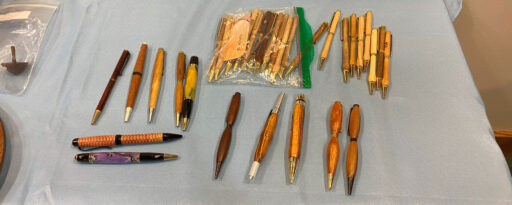
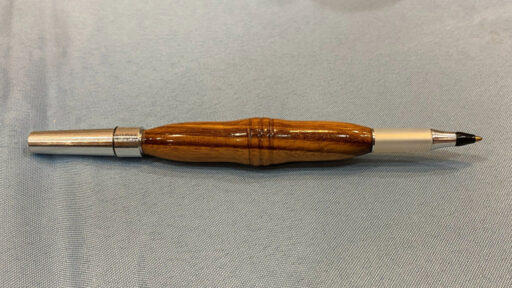
- Demonstration: Turning pens by Tina
- Break
- Reminders and updates
- Review of “President’s Challenge” items
- Show & Tell
President’s Challenge
April: Any item turned using one or both of these techniques: roughing with a skew and back hollowing.
May: One or more pens. Think Pens for Troops
Upcoming Meetings and Demos
May 20 2026: TBD
President’s Message
Ars Longa Vita Brevis
Wikipedia explains ars longa, vita brevis as a Latin translation of a Greek aphorism, roughly meaning: skill takes time, and life is short.
This thought came to mind recently when I acquired a large lathe — a Woodfast MC908 — as an upgrade from the Jet mini lathe (JML-1014VS) I purchased in 2005.
The previous owner had cared for the Woodfast lovingly, but he was no longer comfortable operating such a large machine. Instead, he wanted a smaller lathe on which he could teach his grandsons and share his enthusiasm for woodturning. We arranged a trade.
Moving the Woodfast out of his small shop required partial disassembly. Even after removing everything possible, the cabinet alone weighs roughly 300 pounds. With some ingenuity, a custom trundle carriage, and a helpful neighbor with a trailer, we managed to transport it safely to my garage shop.
By comparison, moving the replacement mini lathe was a walk in the park. I included several chucks and fittings, as he was equipped for 1-1/4″ spindle hardware. Mounted on its stand with locking casters, the mini lathe should be ideal for his downsized shop, and for teaching the next generation.
The arrival of such a large lathe in my garage required some re-arranging. I installed heavy-duty casters so the Woodfast can be moved as necessary, and I took the opportunity to improve my wood storage with a boltless shelving unit mounted on a reinforced rolling base.
Around the same time, I received an email from a woman asking whether she could list her late husband’s lathe on our club mailing list. I offered to help assess and prepare it for sale. It turned out to be another large machine — a Grizzly G1495 — also a single-owner lathe in excellent condition.
Working through all of this brought two observations to mind.
First, we are merely temporary stewards of these machines. Large lathes are substantial investments, and often pass through several owners over their working lives. Many members of our club have helped families disperse the equipment of woodturning estates. Taking good care of our tools ensures they will continue serving turners long after we are finished with them.
Second, it is remarkably easy to accumulate more wood than one could possibly turn in a lifetime. The famous “10,000-hour rule” suggests roughly five years of full-time effort to master a craft. Many of us, especially in our later decades, may never reach that number of hours at the lathe. Some members therefore put themselves on a wood “diet.” Newcomers face the opposite temptation, but should beware of letting their eyes become bigger than their turning time.
Ars longa, vita brevis indeed.
– Edgar Whipple, President
Woodturning Book Library
A large woodturning and carving library is available to WBW members as part of our partnership with the Santa Clara Valley Carvers. Browse the online catalog, reserve a book or two, and pick them up at our next meeting. Some books feature galleries for inspiration, and some describe hands-on turning techniques.
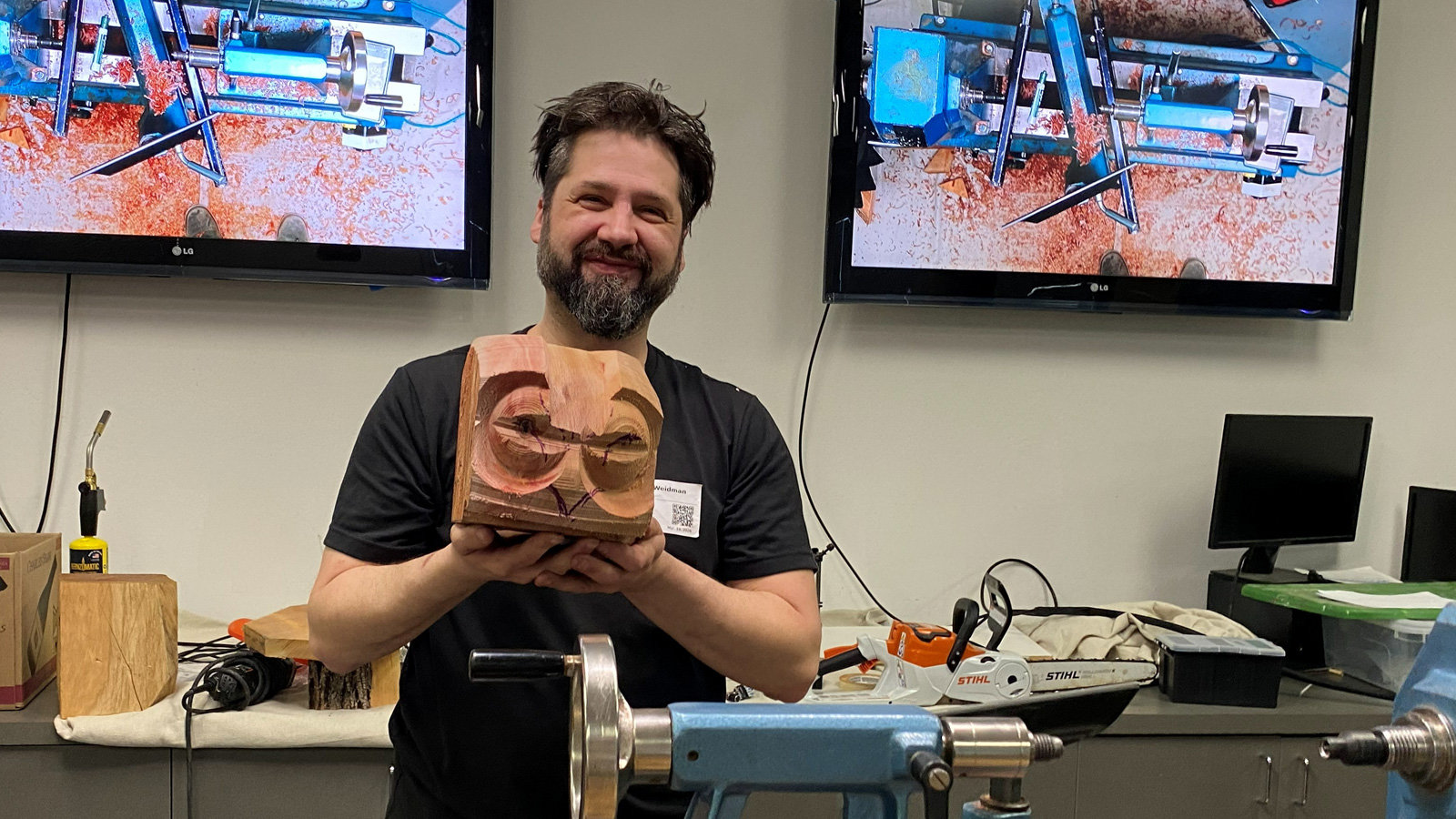
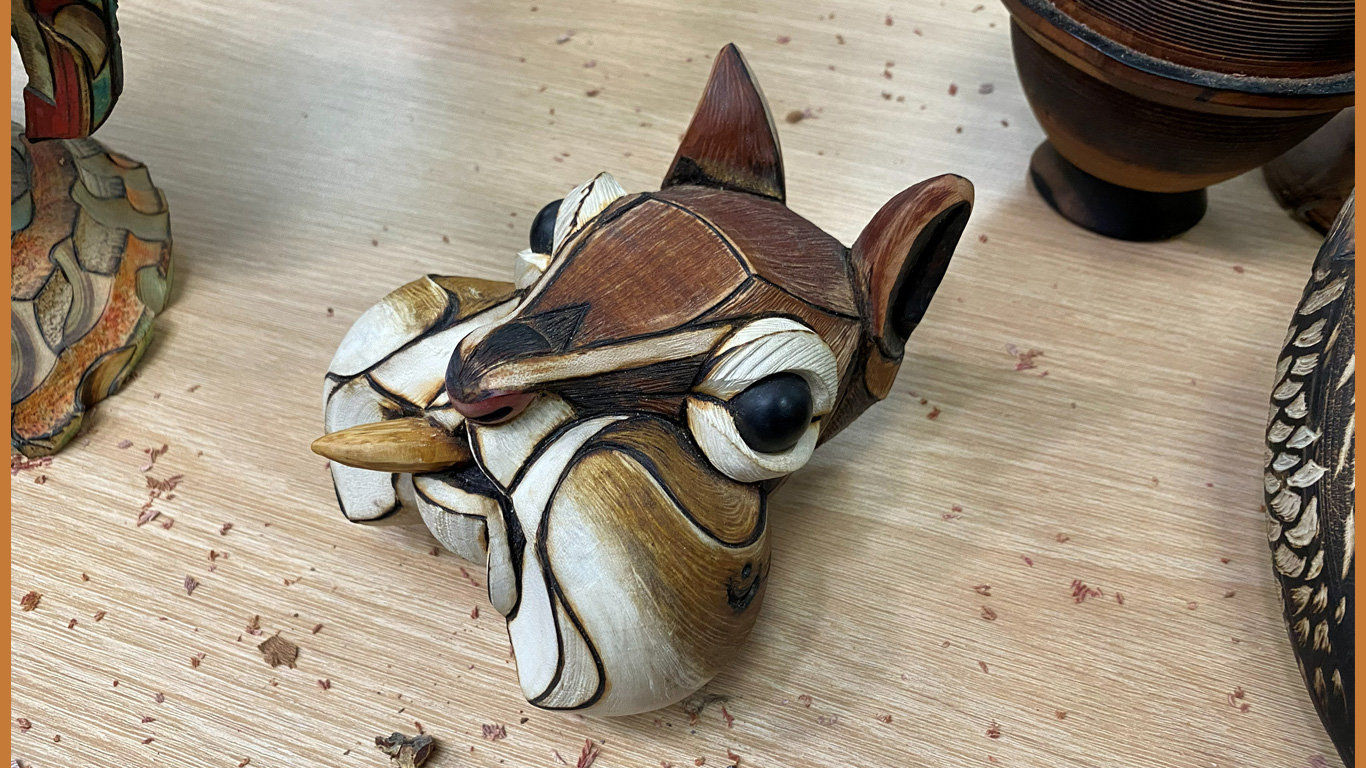
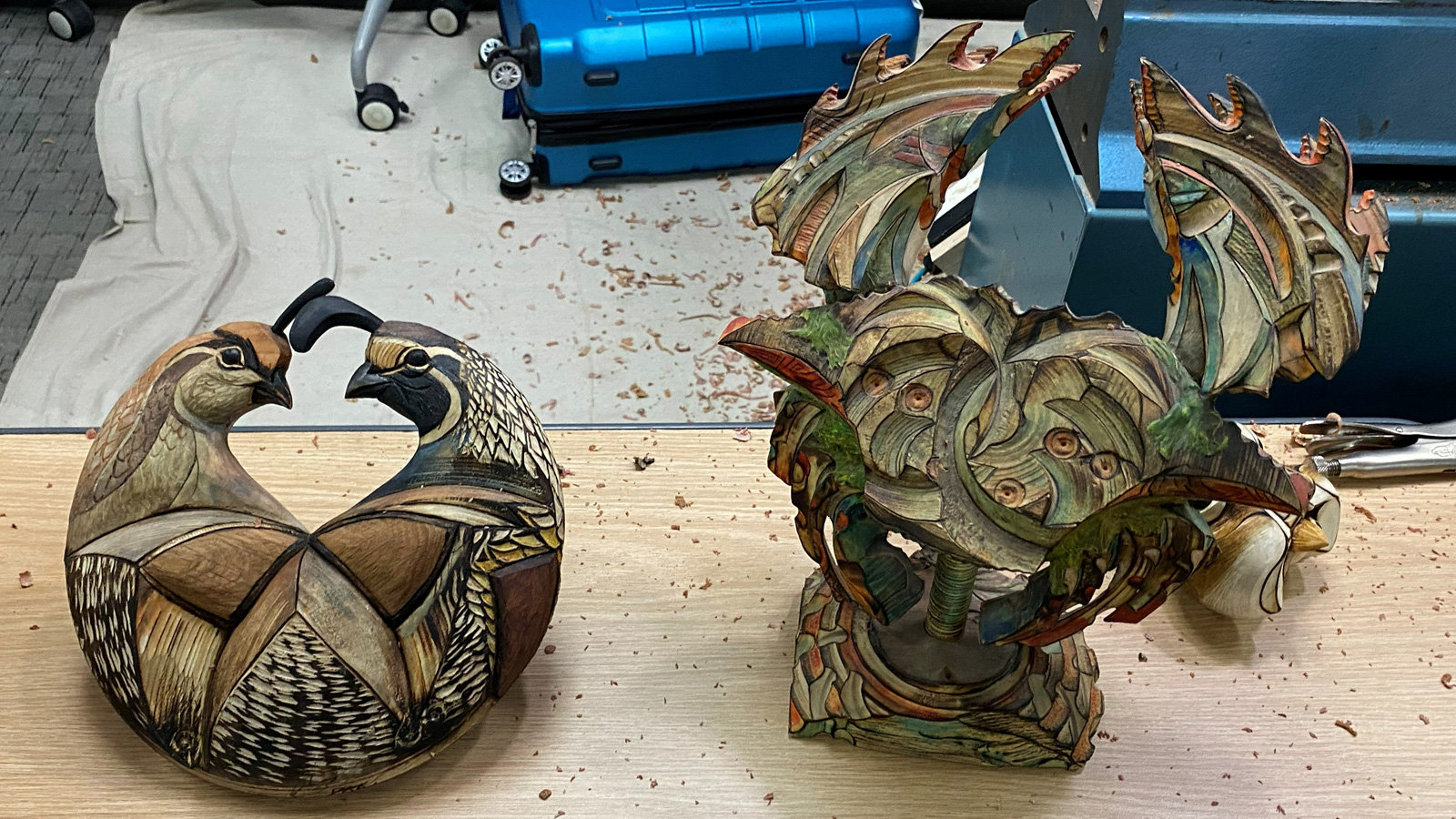
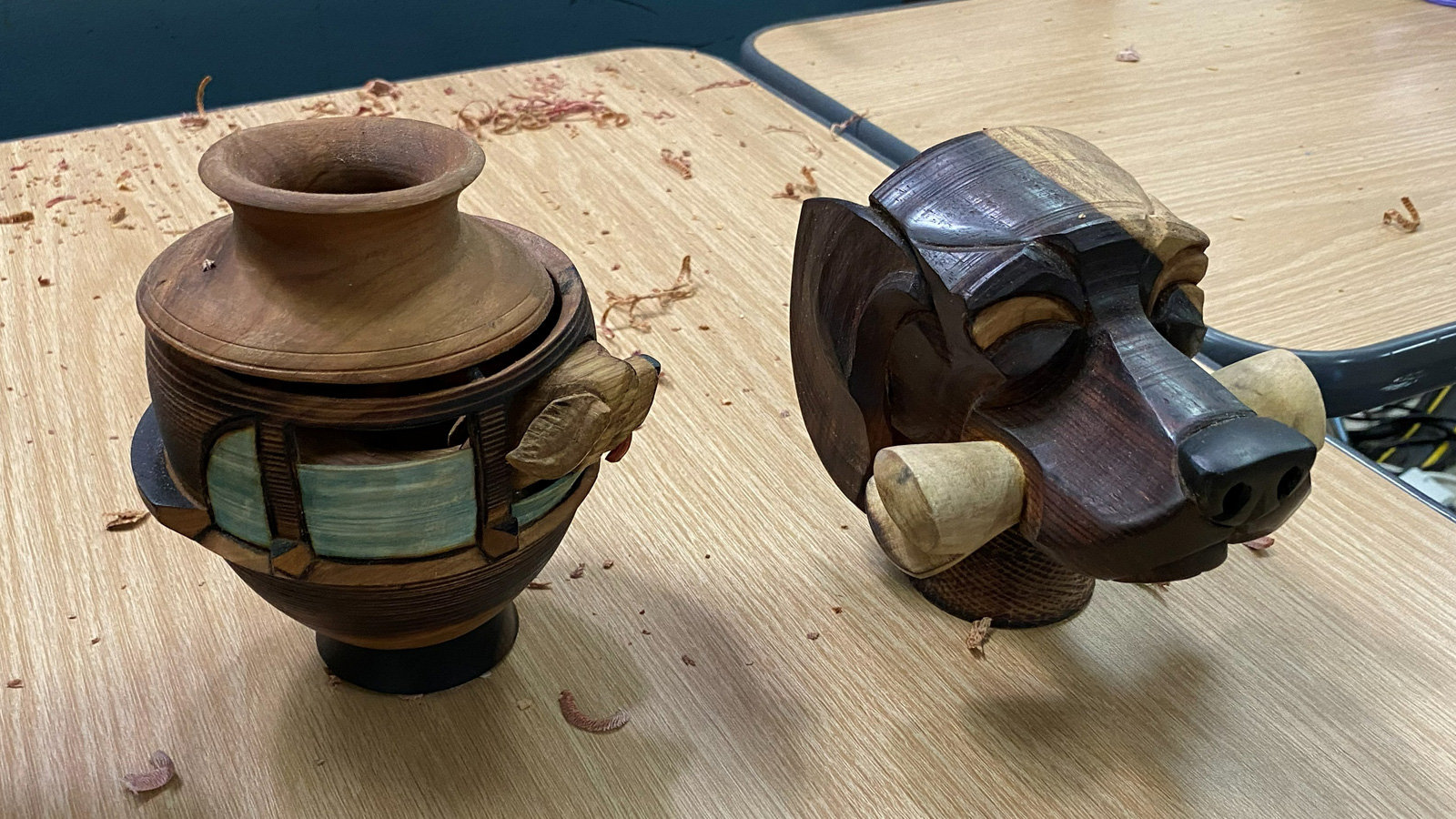
Derek Weidman’s Multi-Axis Woodturning Demo
Derek presented multi-axis turning on March 15, 2026 at Maker Nexus in Sunnyvale, CA.
Last Meeting Review
Wednesday March 18, 2026
Woodturners newsletter notes by Laura Rhodes; pictures by Roman Chernikov and Angela Gunn.
Announcements
- Laura Rhodes spoke about the upcoming fine woodworking show sponsored by the Bay Area Woodworkers Association. It will be held the first weekend in May at Woodcraft in San Carlos. Entry in the show is open to both members and non-members. See bayareawoodworkers.org for more information.
- Woodcraft owner Eric McCrystal gave Edgar Whipple a deal on gift cards. We will use them as President’s Challenge and Show & Tell prizes.
- Jim Koren gave the Treasurer’s report:
- Our rent at Bridges Community Church went up considerably at the start of the new year. Jim is exploring alternative meeting locations, including the Cupertino Middle School Wood Shop.
- The Derek Weidman demo had 37 attendees.
- The board needs to vote for the Member at Large position on the board. Bob Bley volunteered for the position, and was duly acclaimed and appointed.
- At our April meeting, Tina will turn a pen or two.
Demonstration – Roughing With A Skew, and Back Hollowing by Edgar Whipple
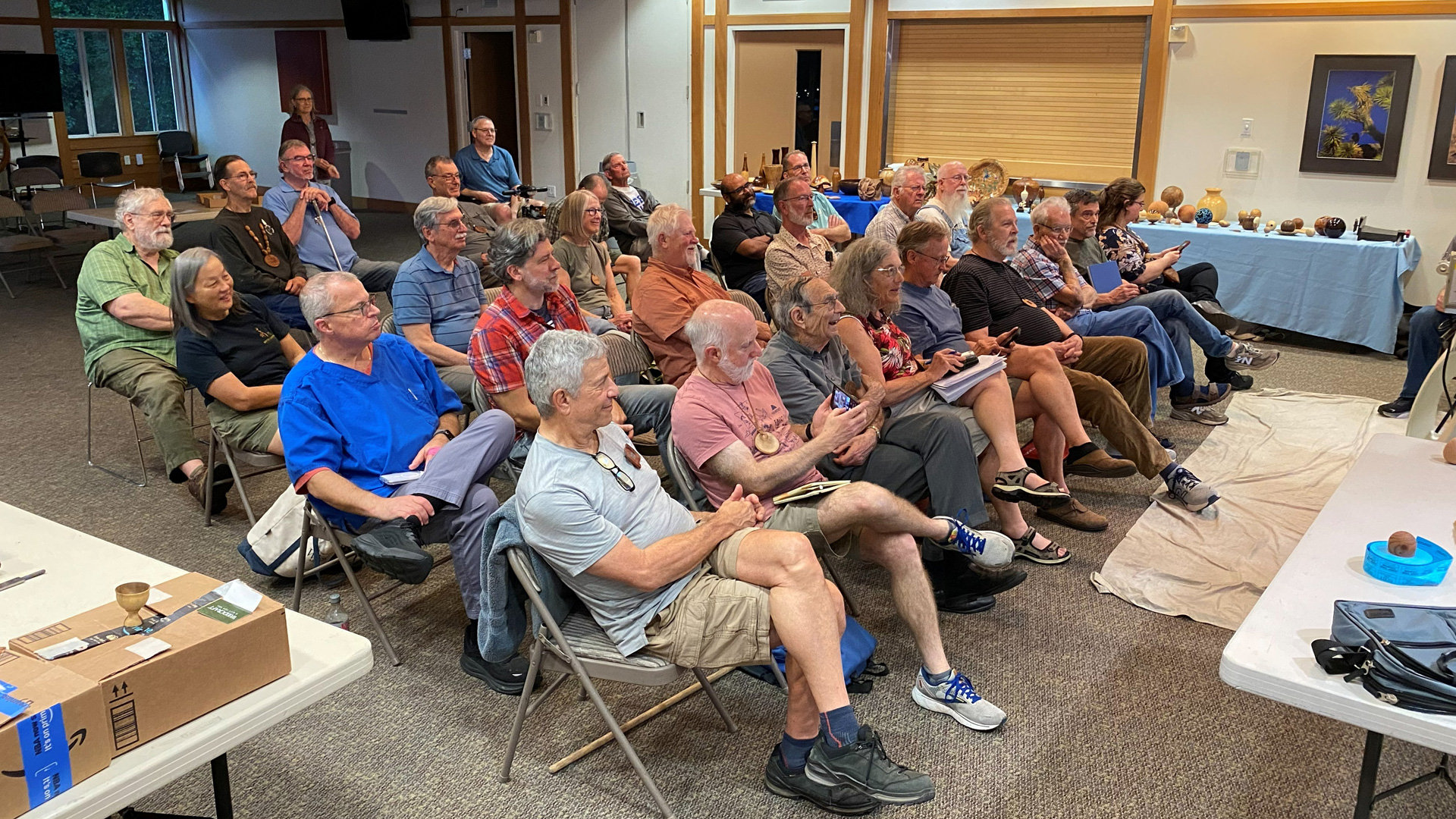
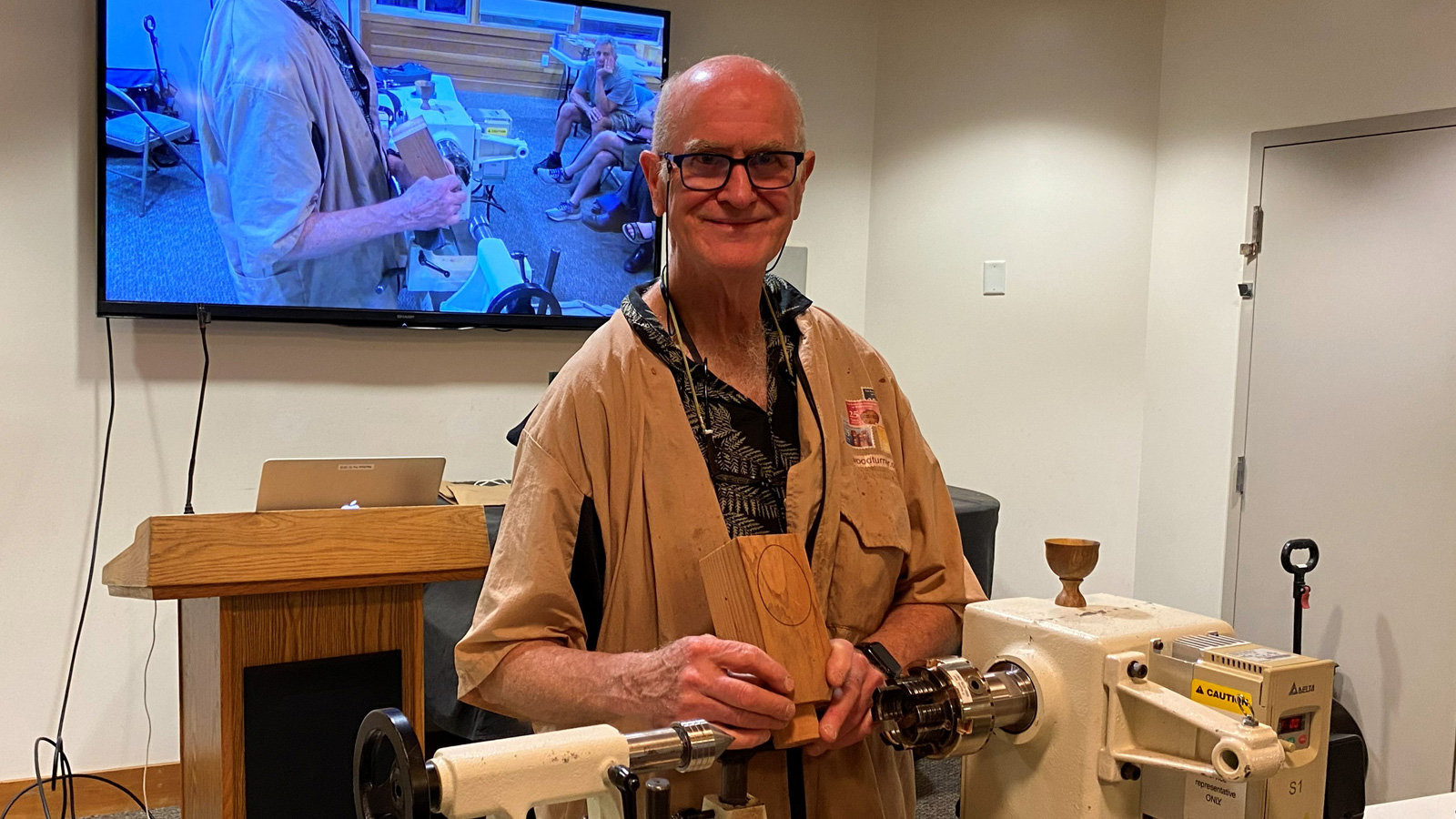
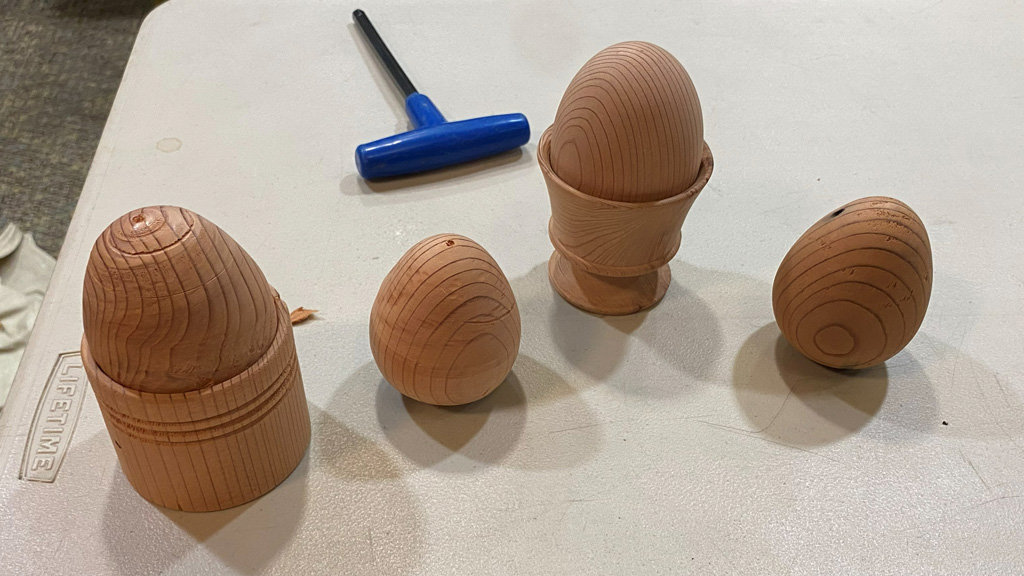
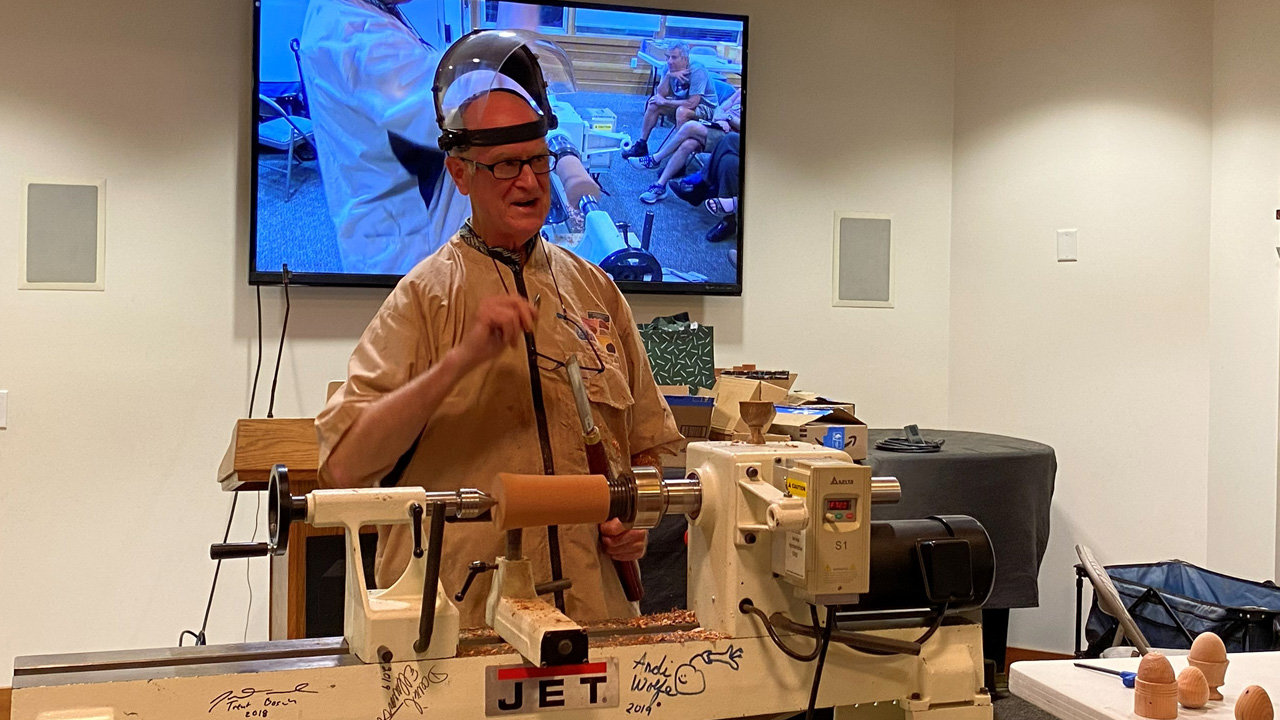
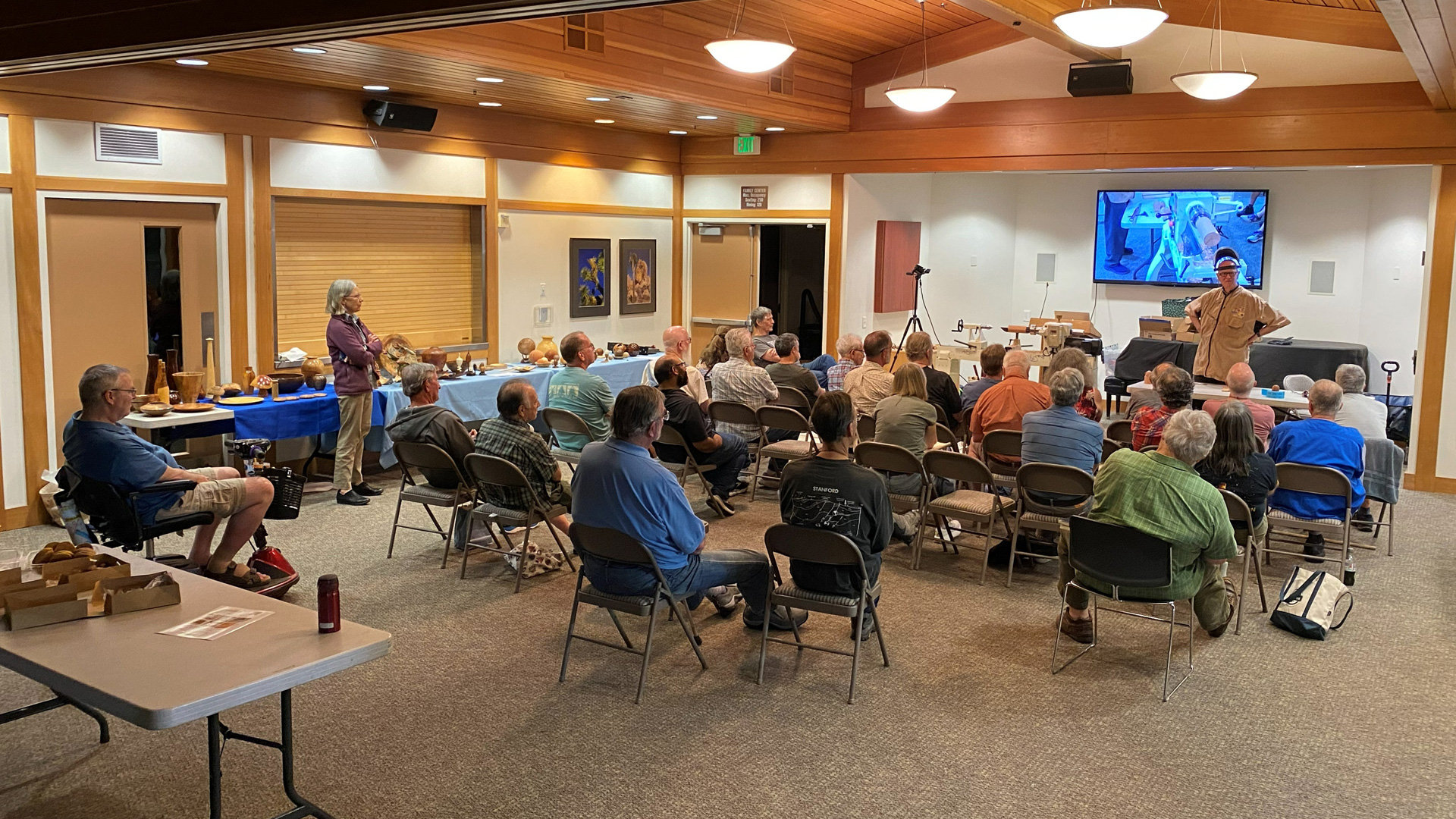
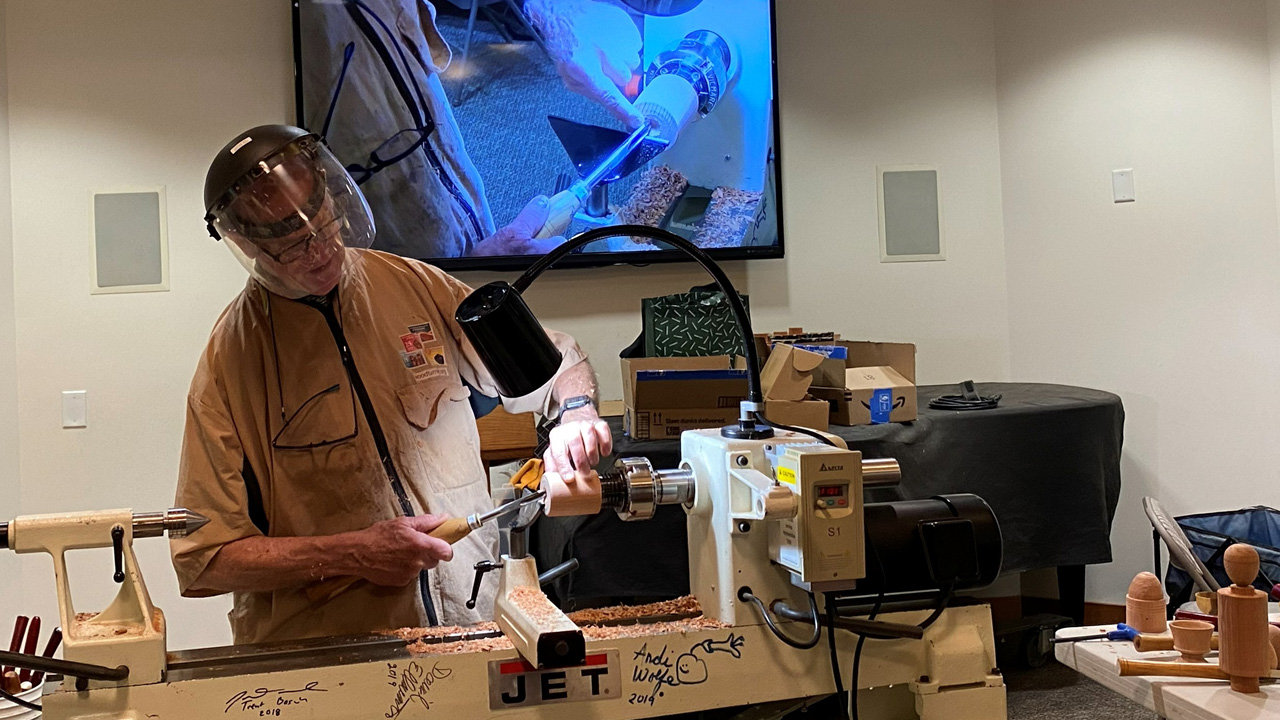
Before he started his demo, Edgar noted that his face shield had reduced visibility as it had become so scratched. Following a YouTube lead, he was able to successfully buff out the scratches using his Beall buffing system with Tripoli wax. The residual wax also minimizes fogging up in cold weather.
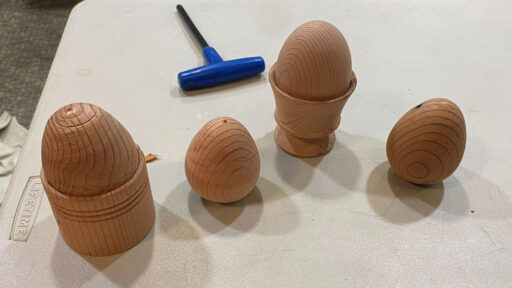
After using the skew to turn his square blank round Edgar marked out for the egg. He turned the large end first at the end furthest from the chuck. Then the narrow end was turned and parted off. The remainder of the blank was to become both the jam chuck (to hold the egg for finishing the narrow point) and the egg cup.
He then demonstrated on the back hollowing technique popularized by Richard Raffan. He used a spindle gouge (with the tip of the tool at the center). This aggressive cut uses the left side of the gouge to quickly remove material. However Edgar had a bit of a catch and the demonstration ended abruptly.
Edgar showed off a beautiful large egg-shaped hollow form made from Koa wood. Edgar purchased it in Hawaii many years ago. The piece is called “Rebirth” and was created by Barry Ching.
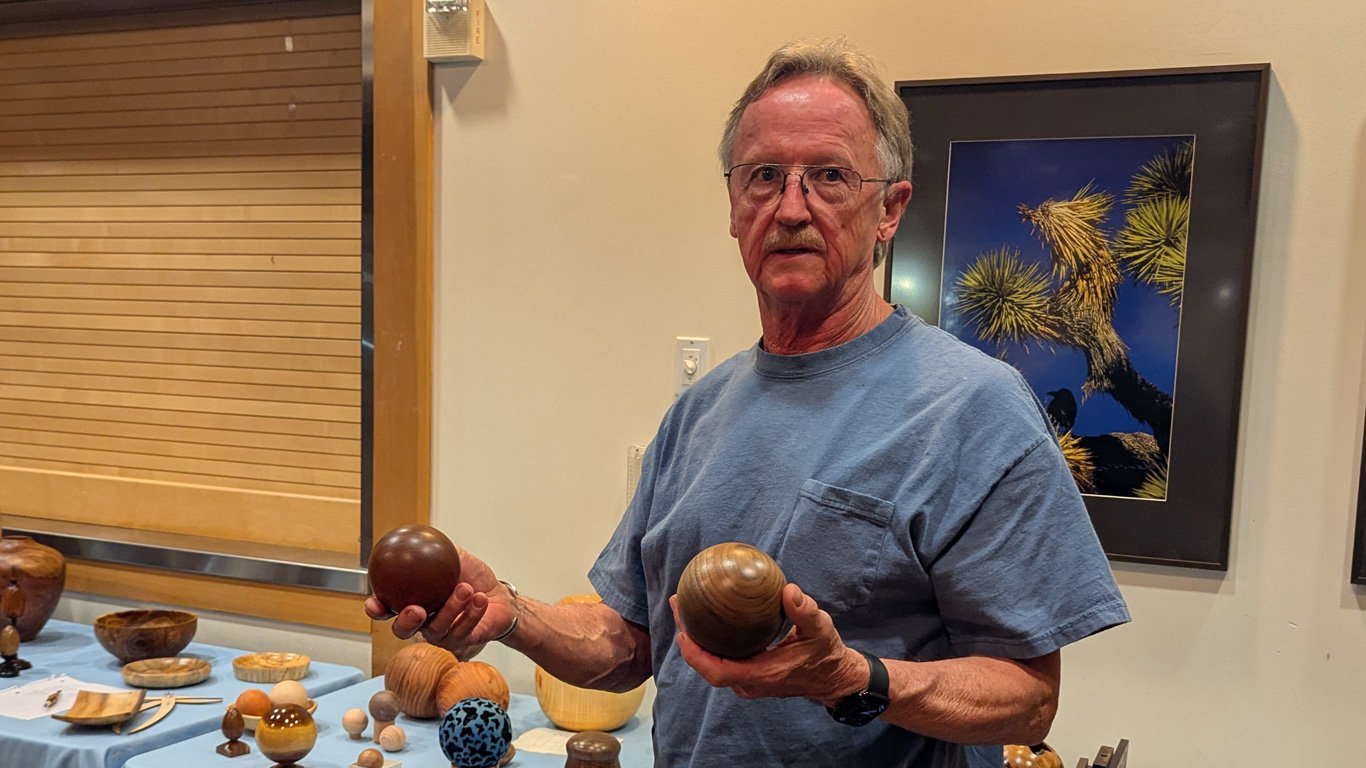
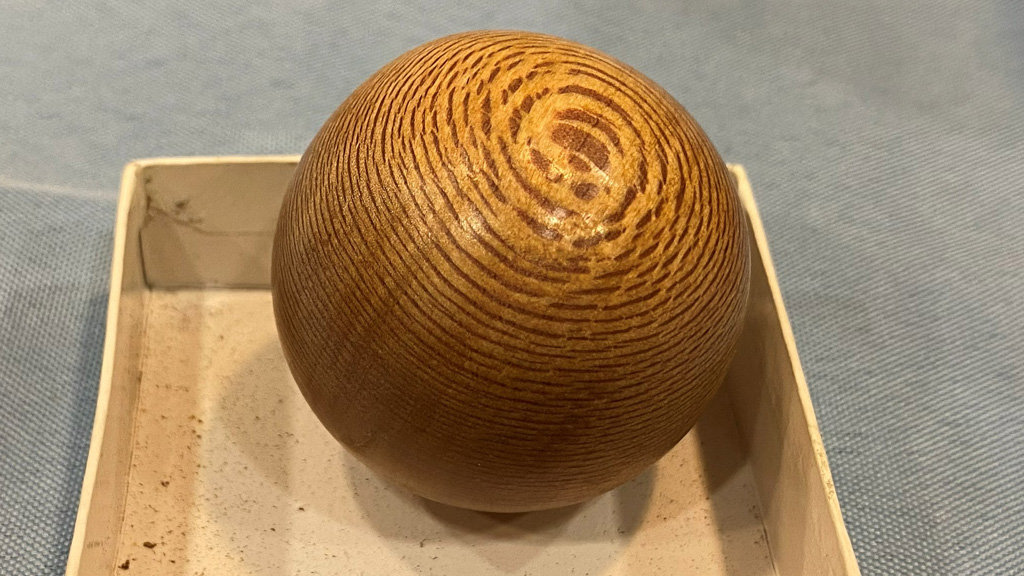
President’s Challenge – Turn a Sphere or an Egg
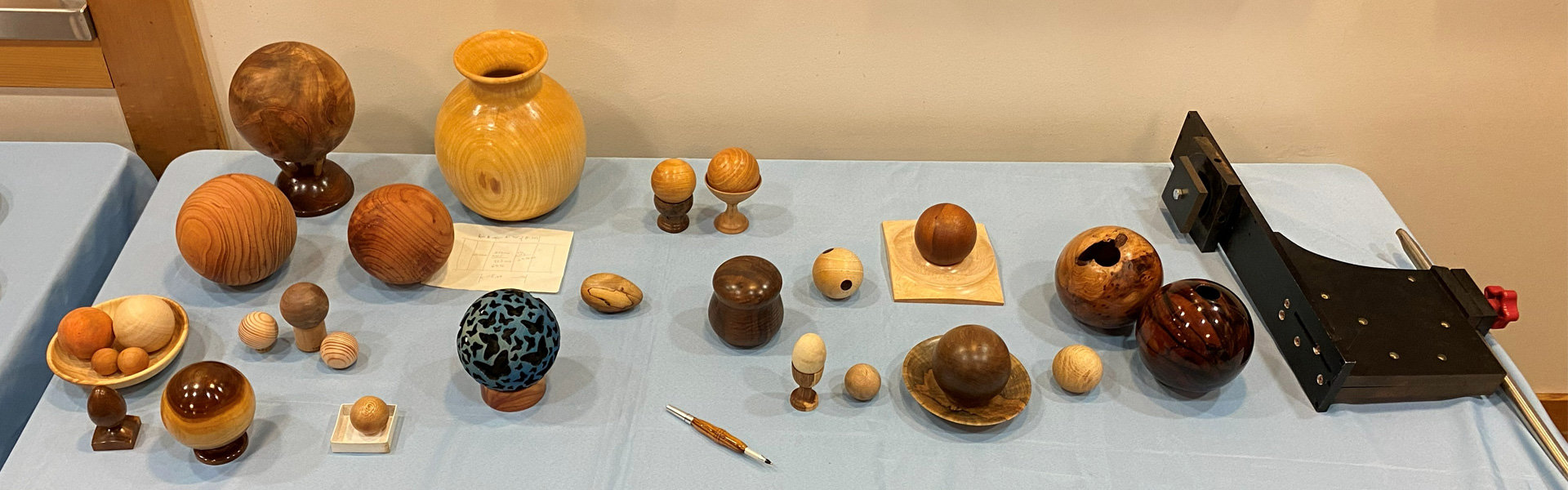
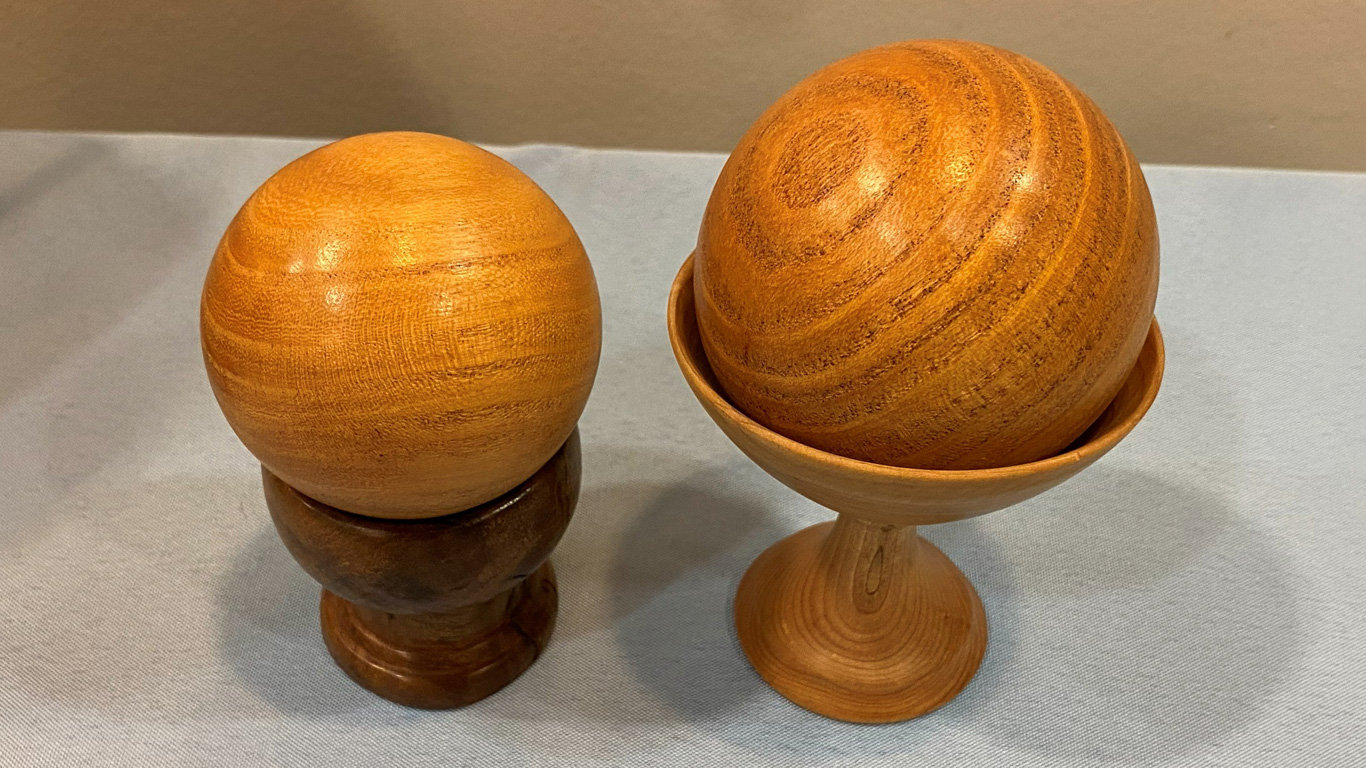
Tom Gaston turned two balls – one of walnut, one of mahogany. He also made special holders for them of Norfolk Island pine and Maple.
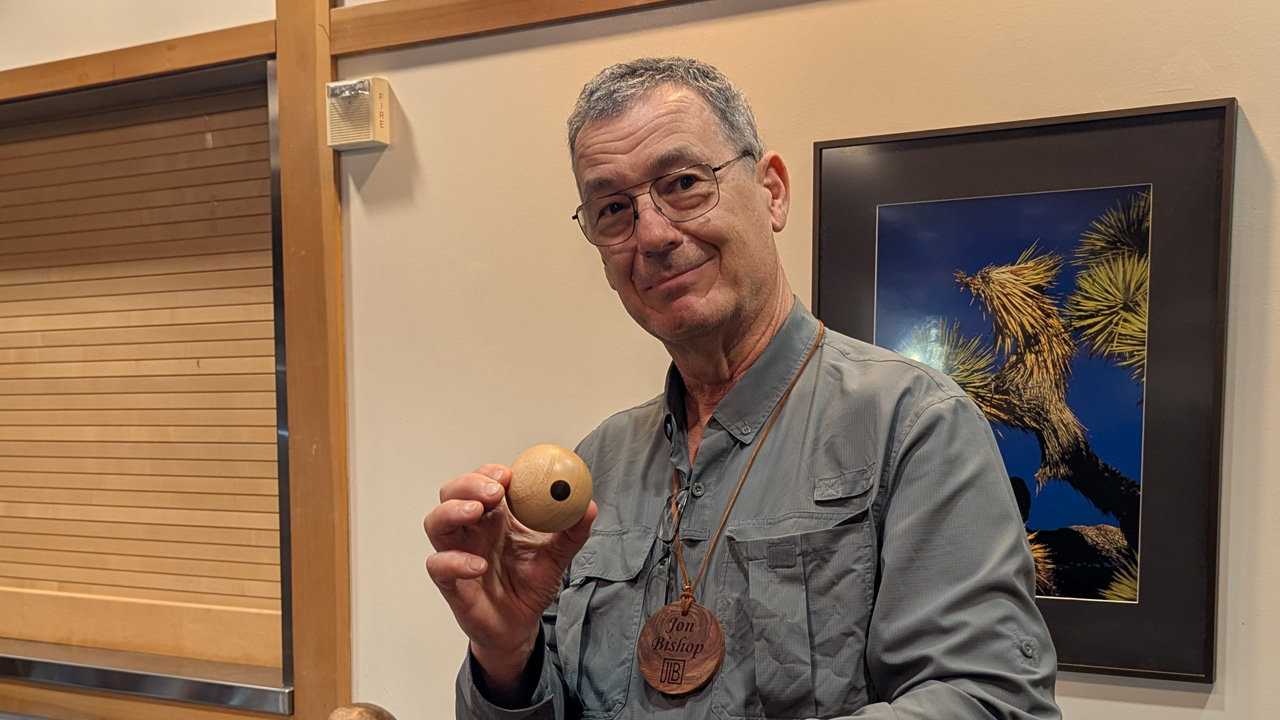
Jon Bishop made a beech sphere with four black Acacia dots.
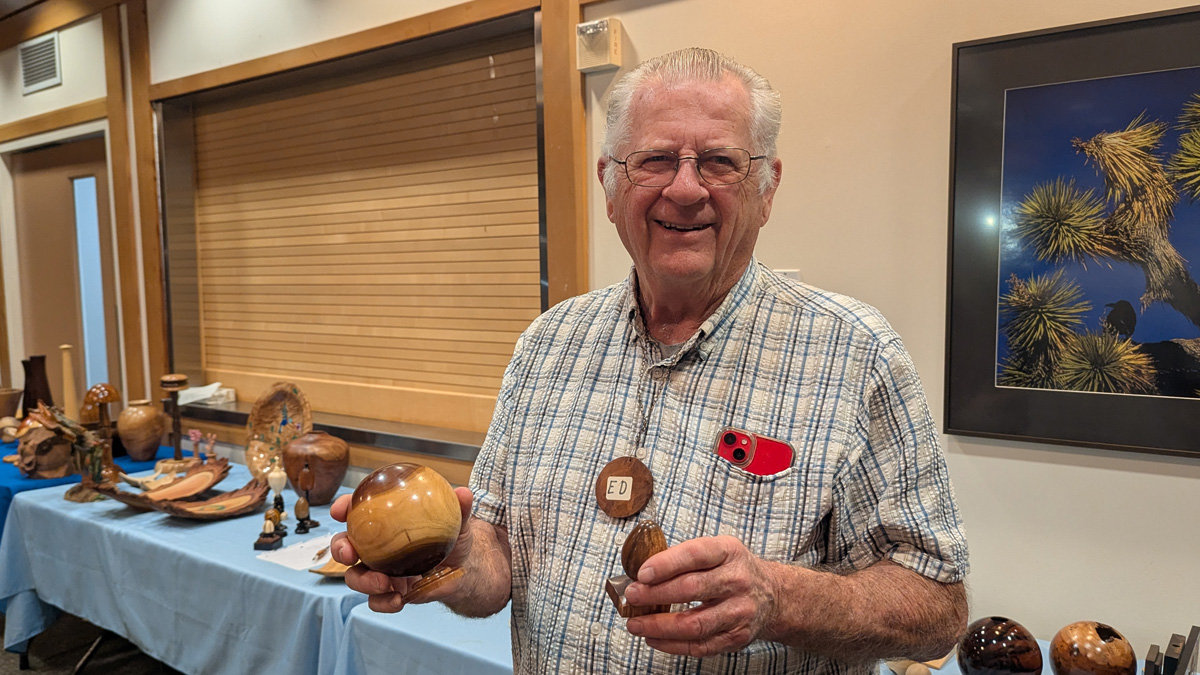
Ed Howes turned an acacia sphere but left it connected to its stand. He also turned a dozen eggs for Easter and showed off one of the walnut ones.
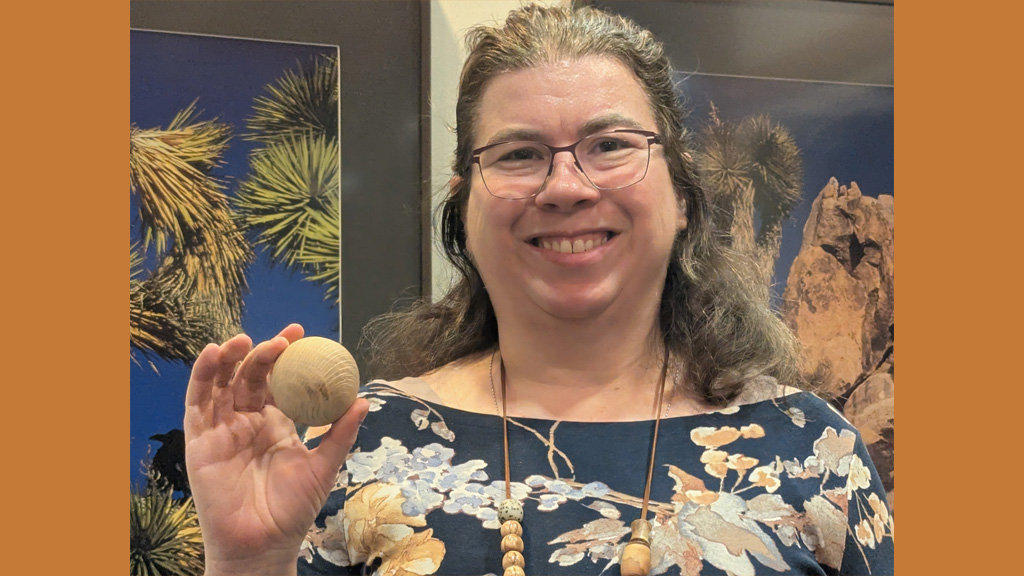
Angela Gunn turned an oak sphere. Her dog was very confused by the wooden ball.
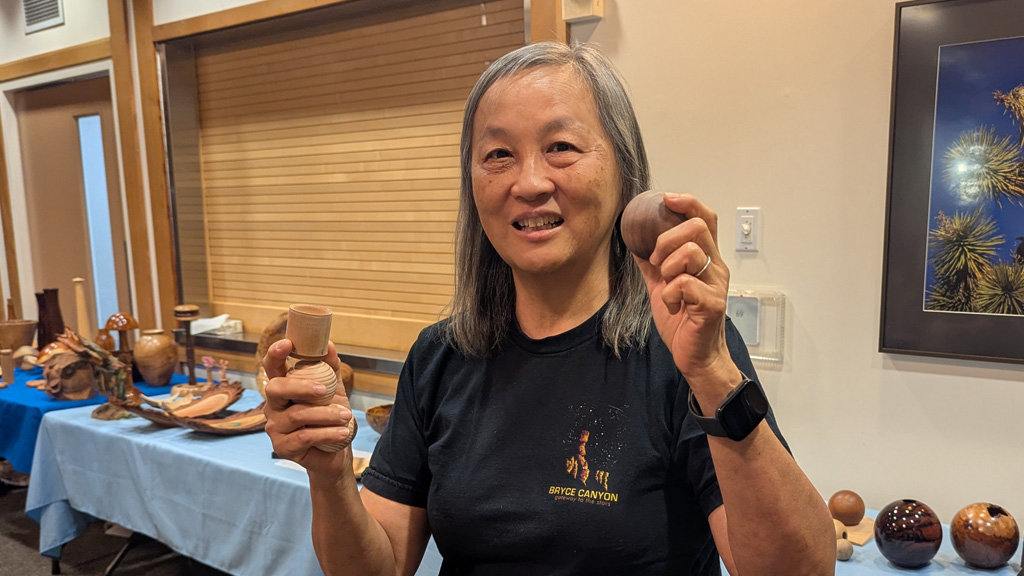
This was the first time Alison Lee turned a sphere. She turned two in tandem and then she made one in walnut. She used a cup chuck (modeled after one by Mike Peace) to hold one end and she used a cork on the live center to hold the other end of the sphere.
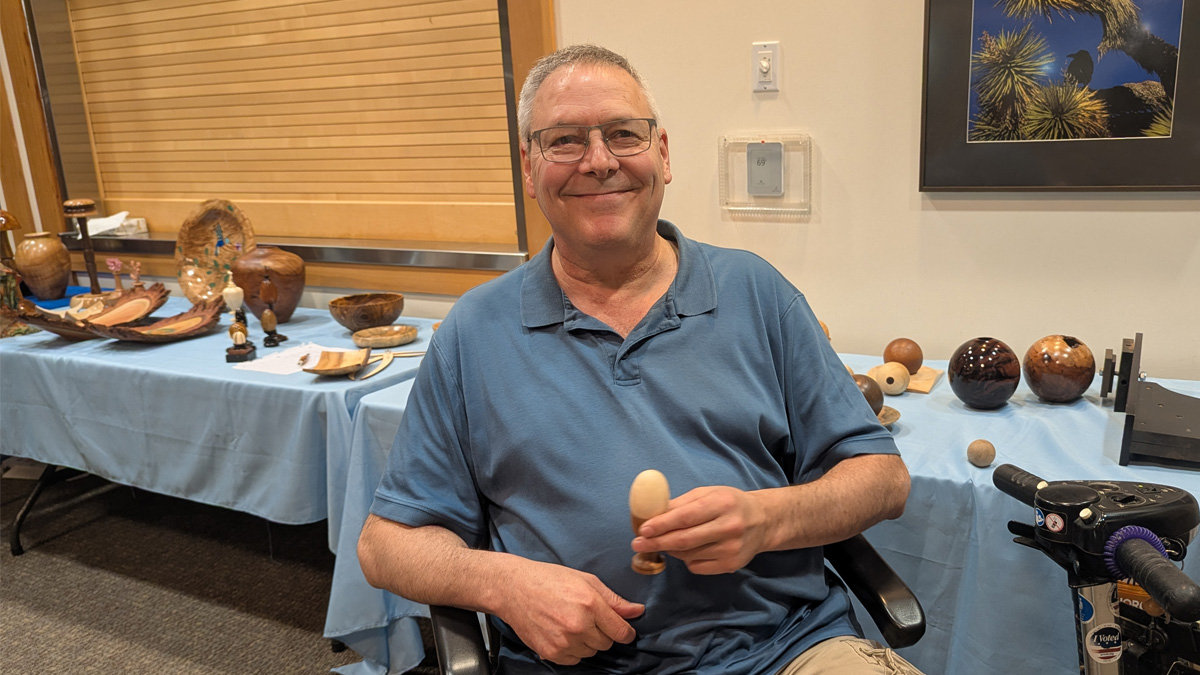
Kevin Lee turned a sphere, an egg, and an egg cup. He turned the egg with the skew while the blank was held between centers.
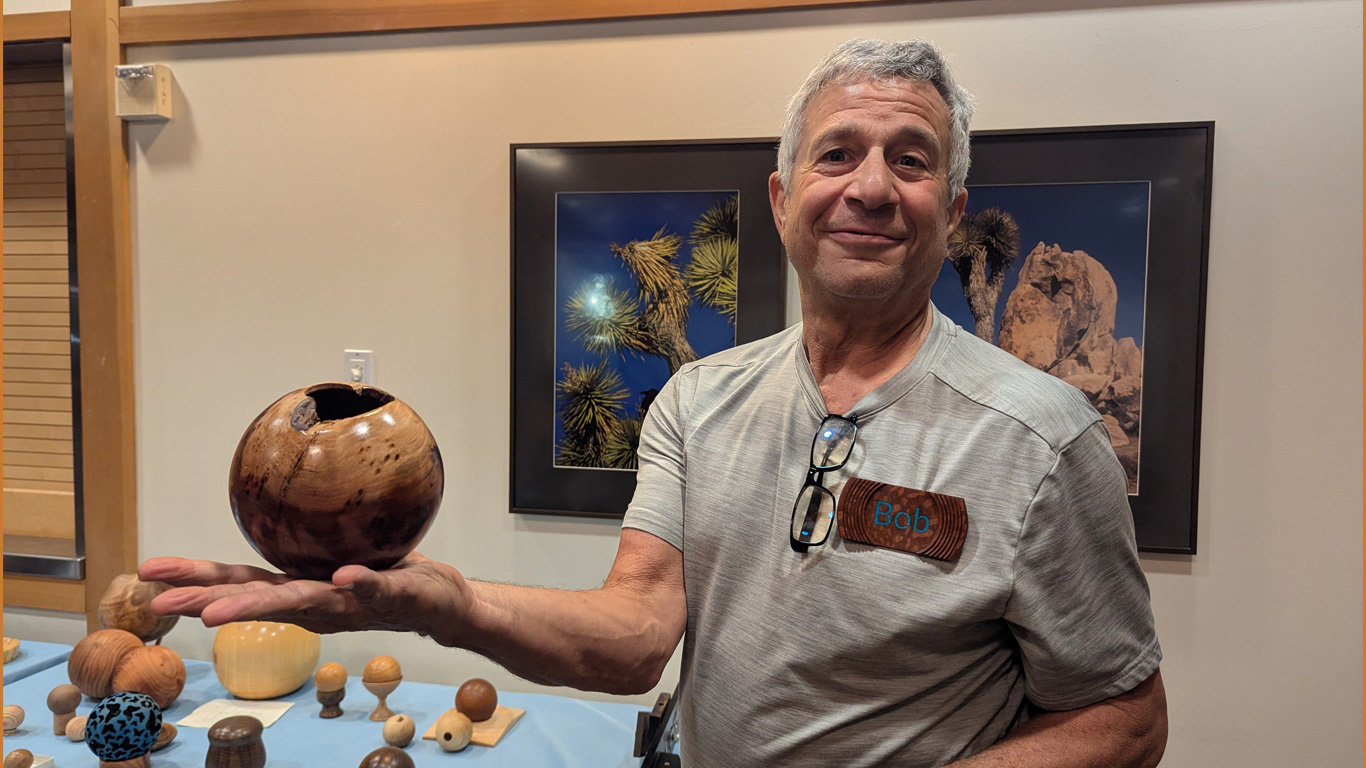
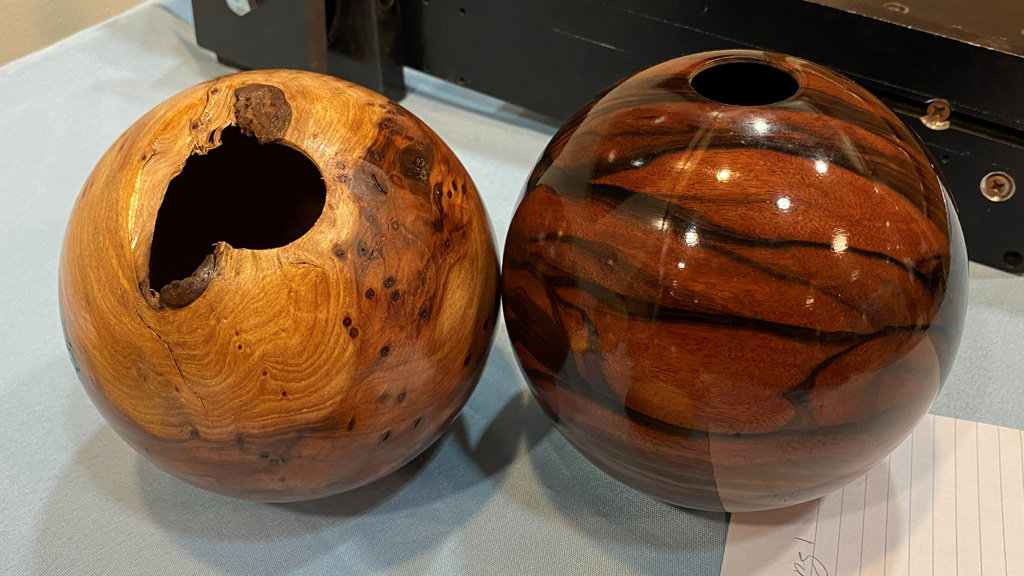
Bob Bley showed a hollowed, natural edge, Redwood burl sphere. He also made a Macassar Ebony hollow sphere with a 1/8 inch flat on the bottom with a CA finish. Bob created his own homemade sphere jig.
Harvey Klein turned a Sycamore sphere.
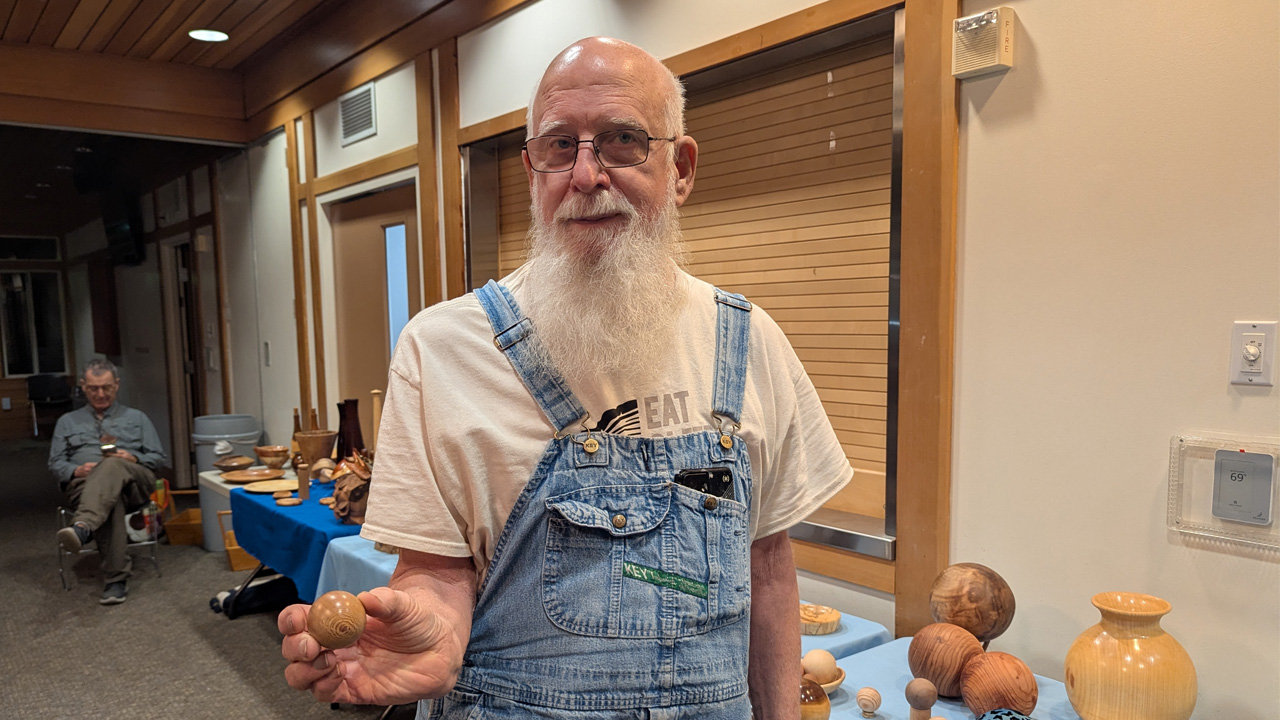
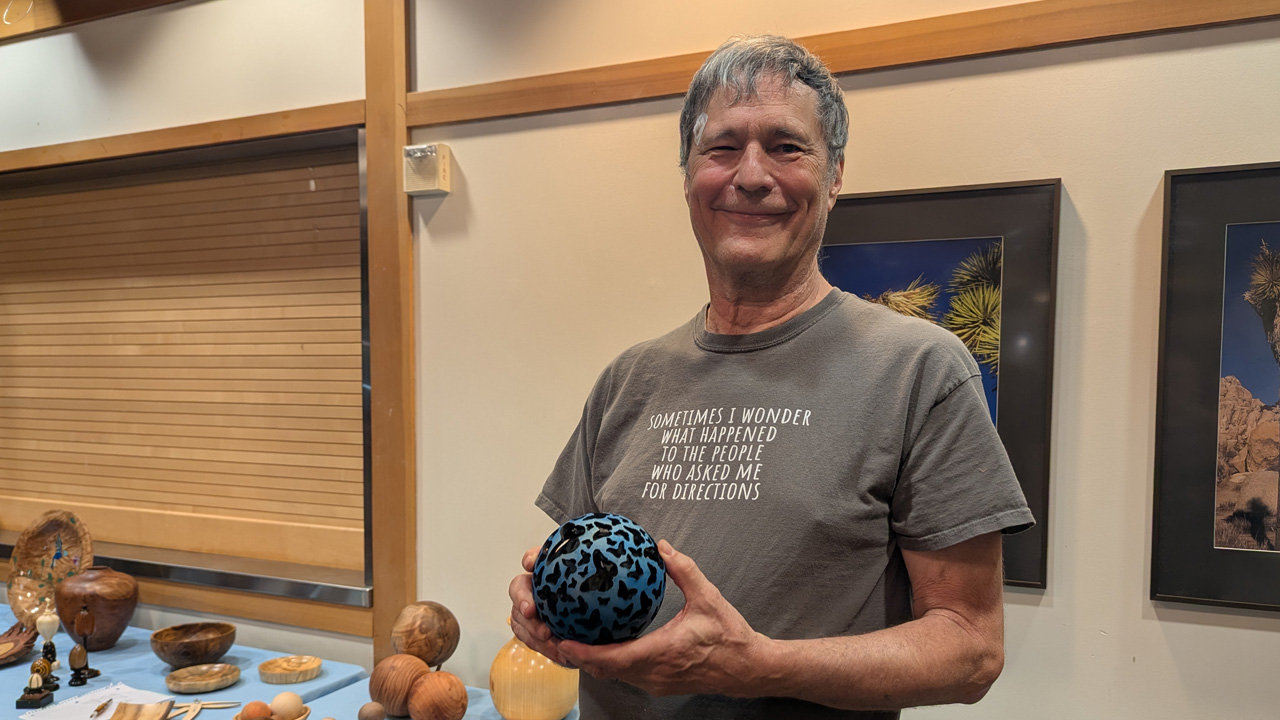
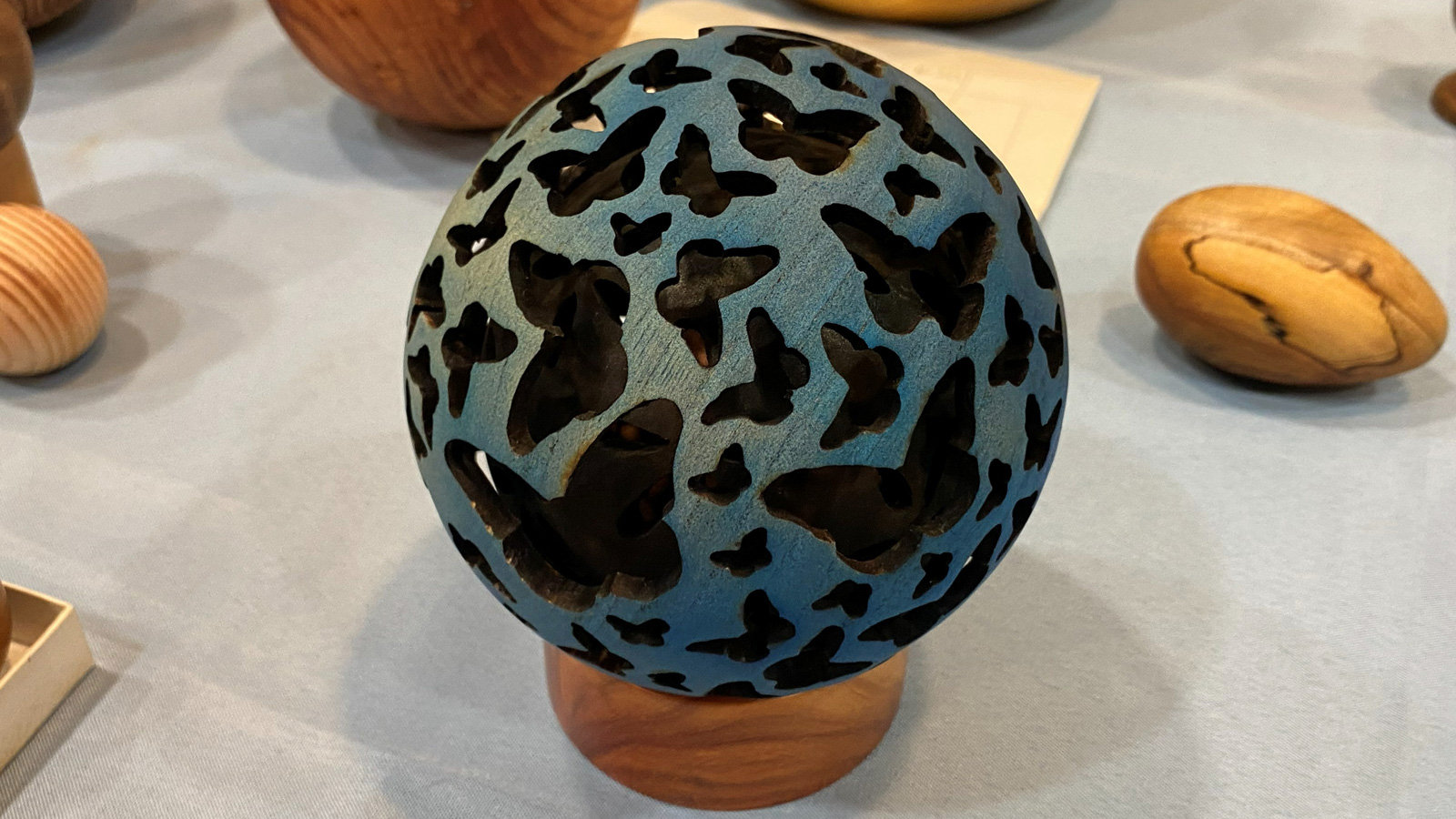
Dave Vannier made a ball inside a ball inside a ball. The outside ball was painted blue and pierced in butterfly shapes to represent the sky. The middle ball represented flowers and the final ball represented the earth. To fabricate this creation, the balls were cut in half and then glued back together before piercing and painting.
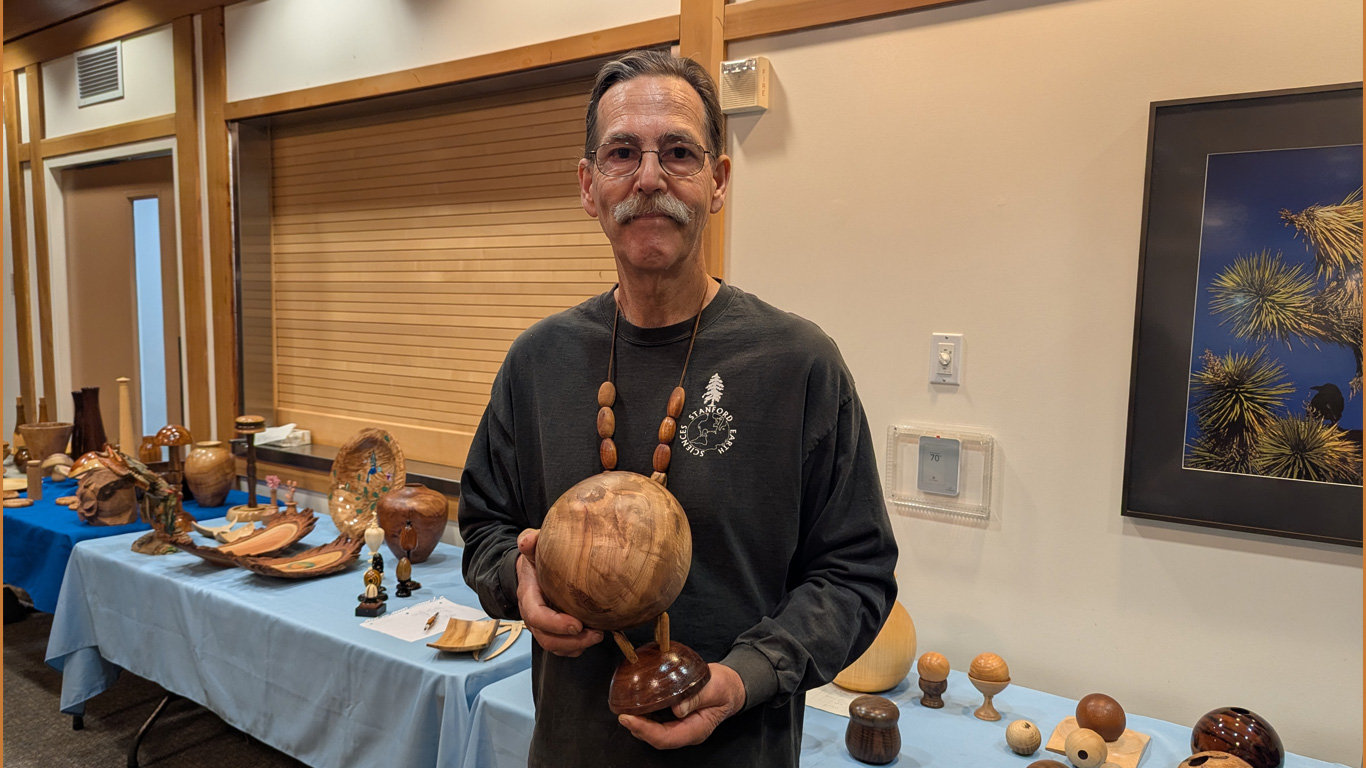
Kelly Smith turned two Redwood balls. He made a Siberian Elm vase using the ball turning math. He also turned a sphere from David’s maple but it went wonky. Kelly made a sphere stand of red gum with Japanese Maple pegs.
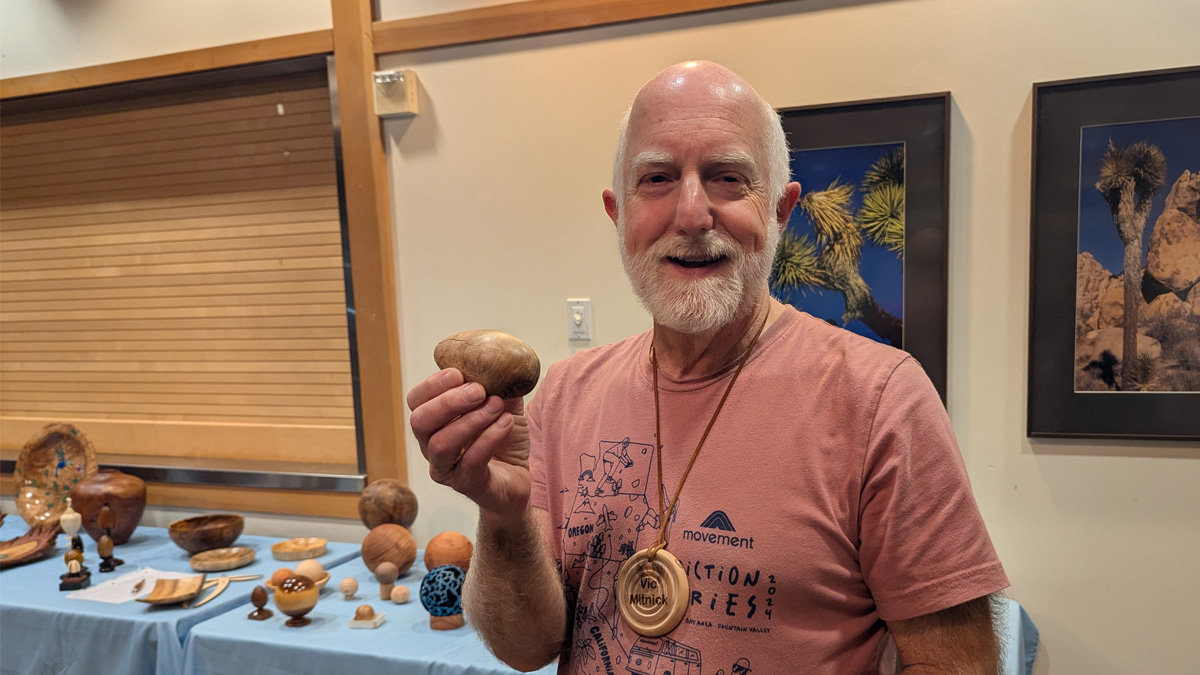
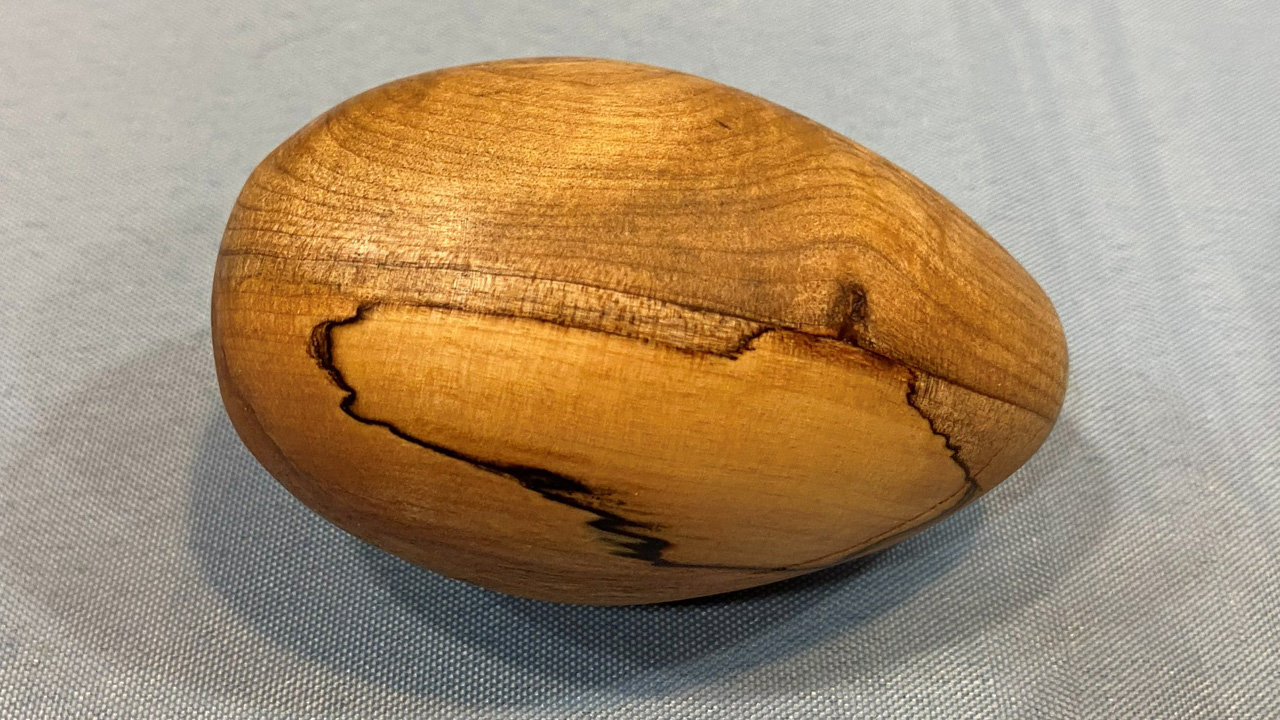
Vic Mitnick turned an egg of an unknown wood with spalting.
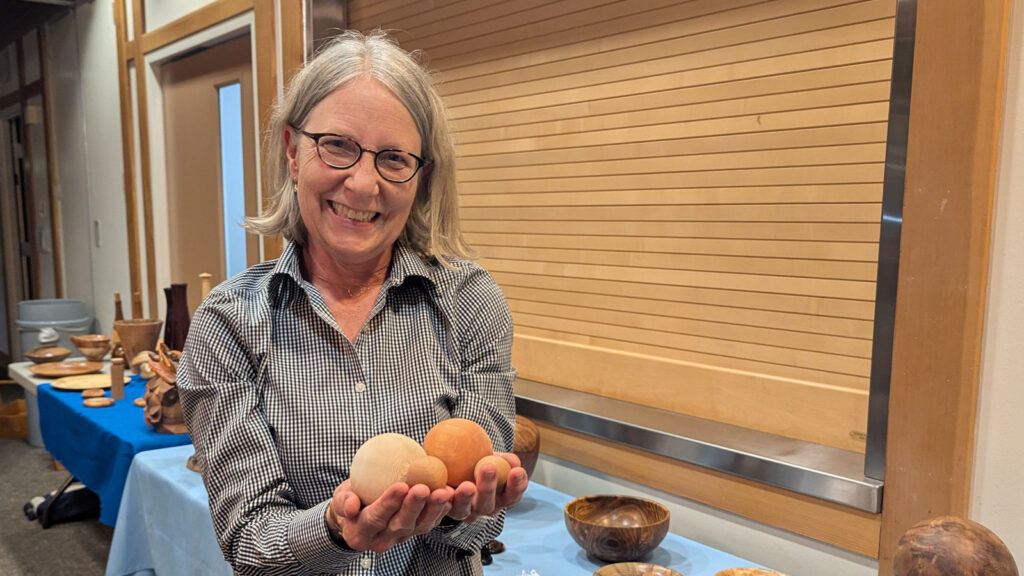
Kirsten Mouradian made three small spheres.
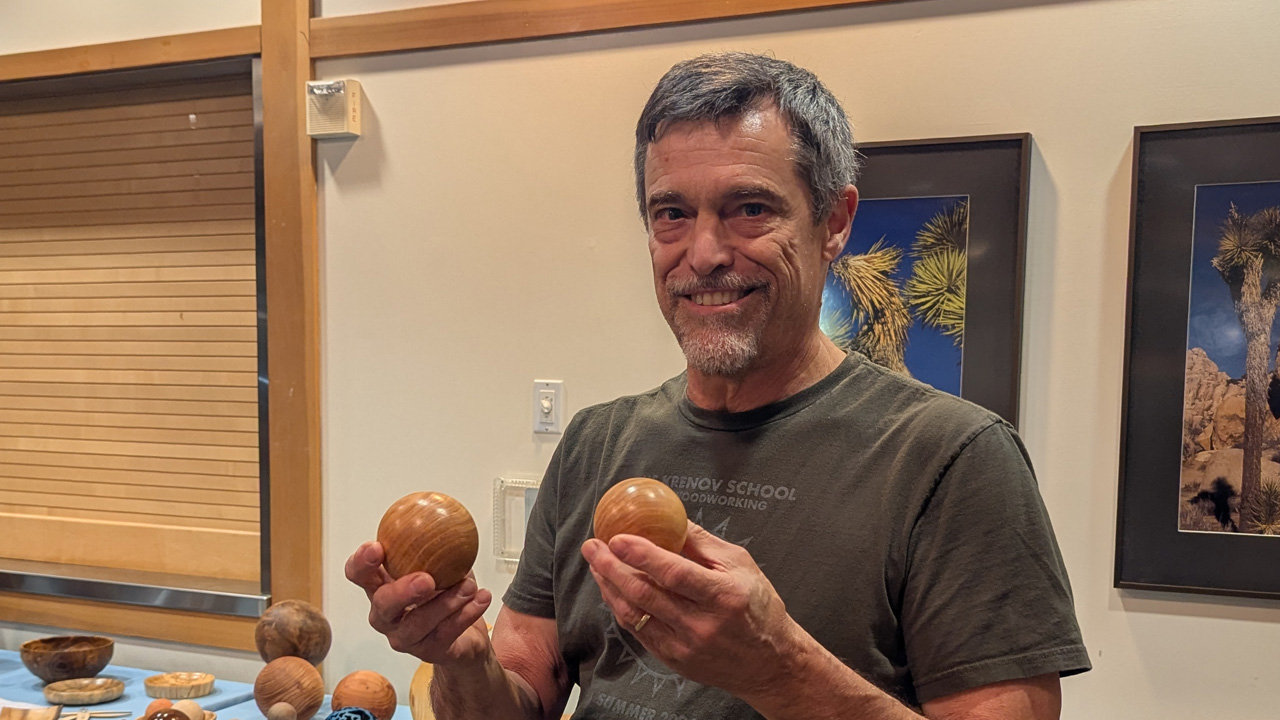
Claude Godcharles brought two honey locust spheres that he made in a class with Stuart Batty many years ago. Over the years, they have warped a little bit.
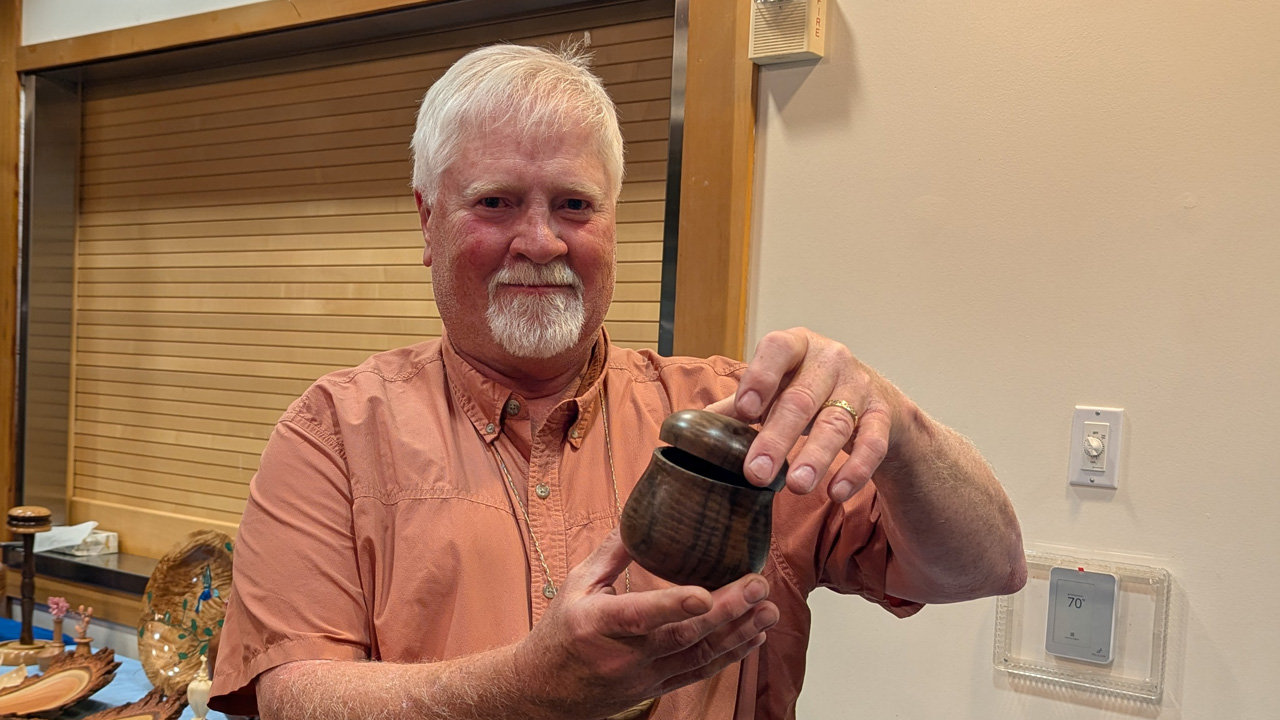
Jim Koren, who missed last month’s meeting, made a Hawaiian-style umeke lidded bowl.
The prizes for the President’s Challenge included a natural edge bowl that Edgar Whipple made from a cored burl given to him by Bob Bley. Bob Bley added his natural edge Redwood burls hollow-form sphere to the prize selection. In addition, there was a black Acacia log, pieces of beech and osage orange, a Woodcraft gift card and three bowl buffs.
Show & Tell
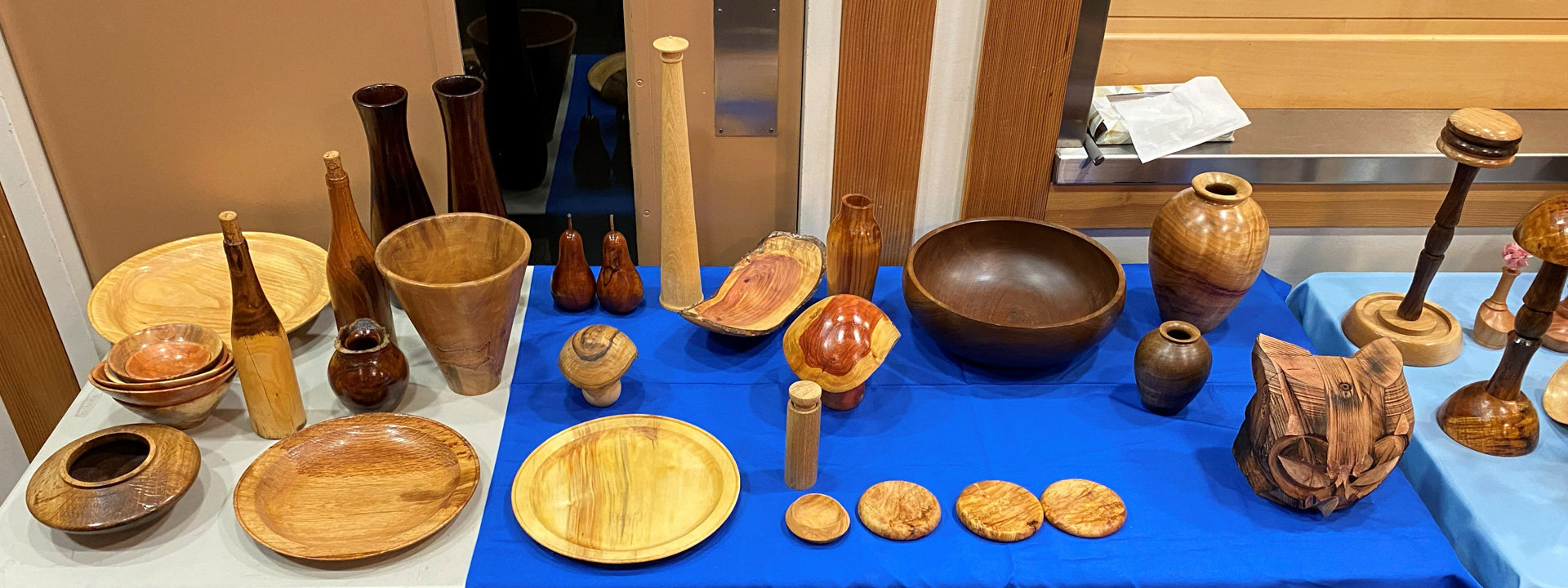
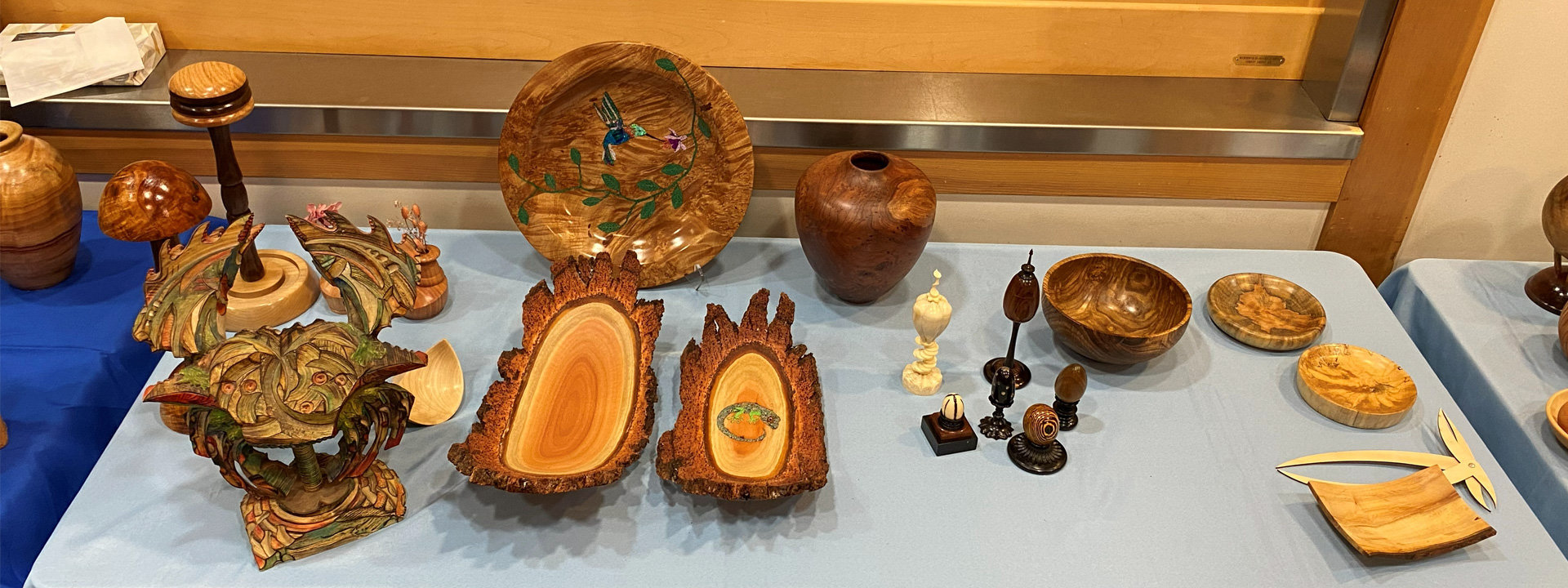
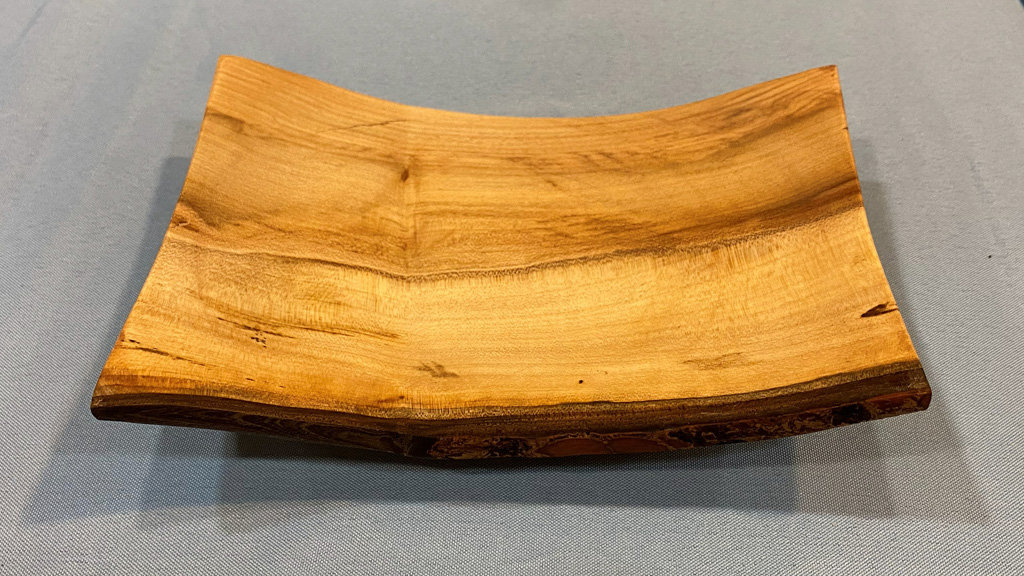
Vic Mitnick made a square Maple bowl. He also showed some custom calipers for determining sphere dimensions.
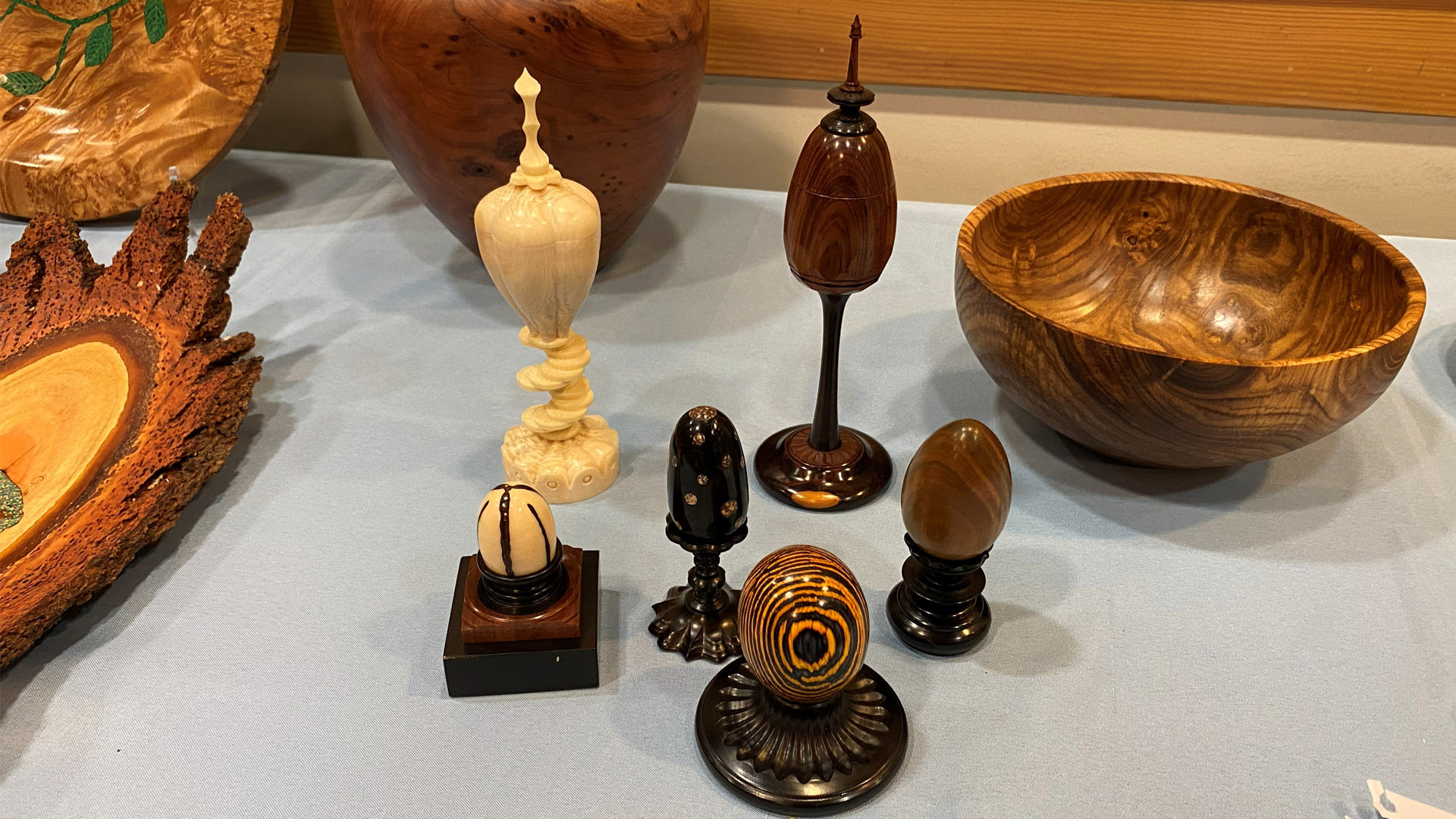
Every year, Jon Sauer turns several eggs for Easter. He showed a few of them made from exotic materials such as a Calamanta nut, Lignum vitae and African Blackwood. Their stands were ornamental turned.
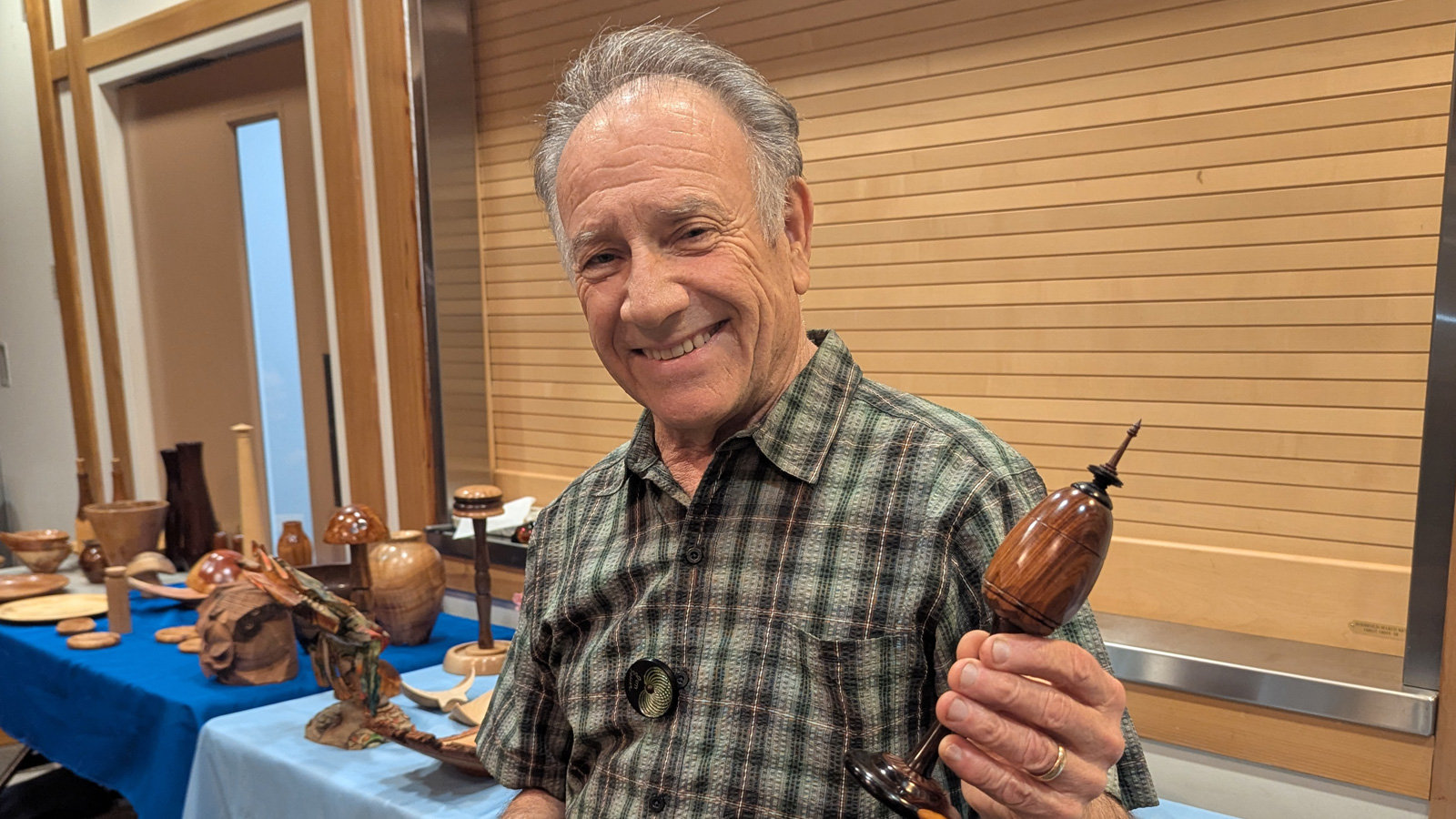
Jon showed an egg case that he made in 1985, Inside there was an amboyna burl egg. The case was made from Kingwood, Ebony, Cocobolo and lignum vitae. Jon also spoke about the speed turning egg cup challenge that used to be held at the Utah symposium. This race was discontinued after one of our WBW members was injured.
Different pieces made by Jon Sauer and Dale Bassman.
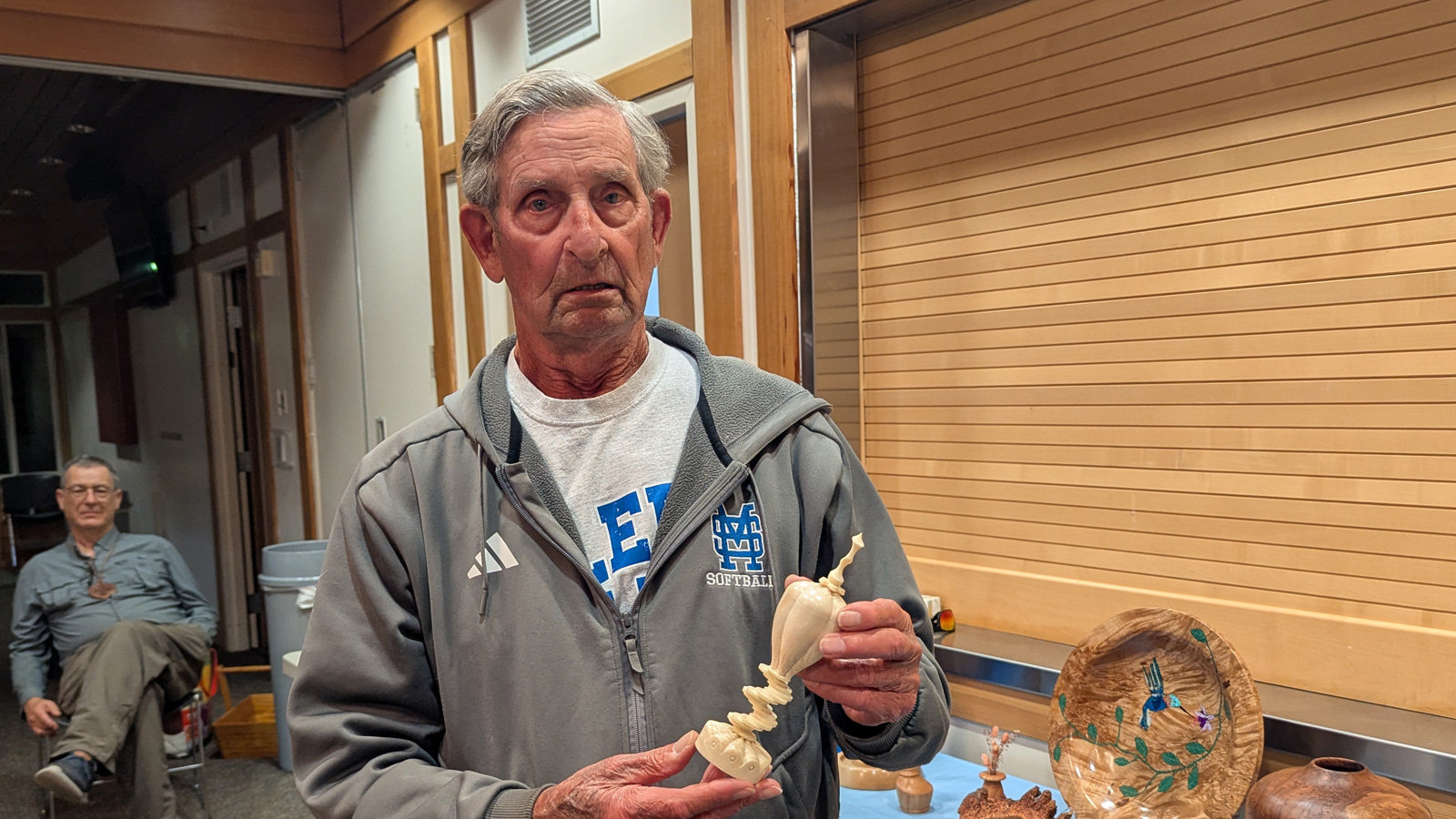
Dale Bassman made a fancy Faux ivory box using his rose engine lathe. It featured a spiral stem created using an eccentric Chuck. Dale said it took him a long time to make the box.
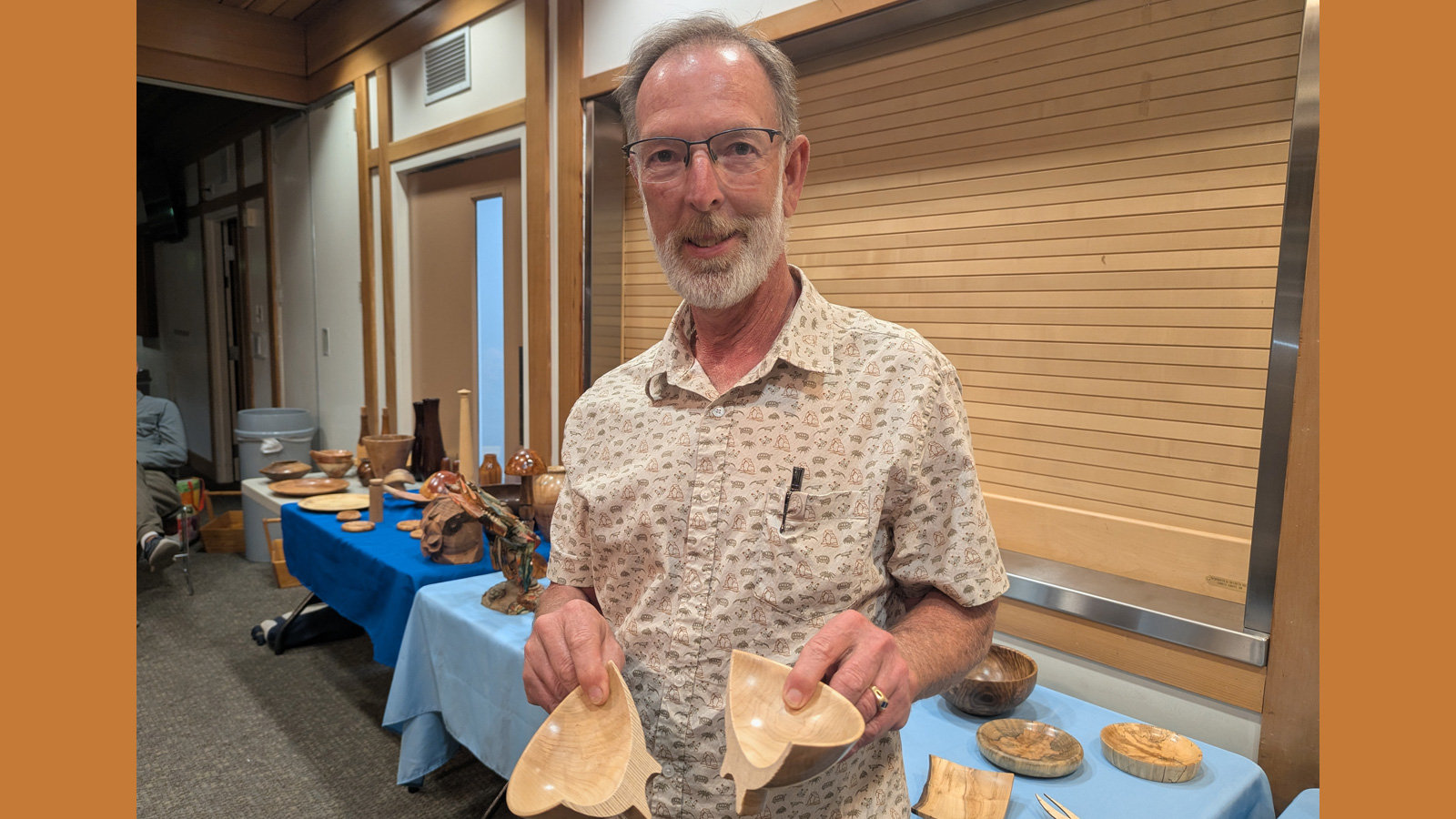
Dean Caudle cut a bowl in half and finished both halves with General Finishes gloss bowl finish. By using Mirka pads on one half, he was able to achieve a matte finish.
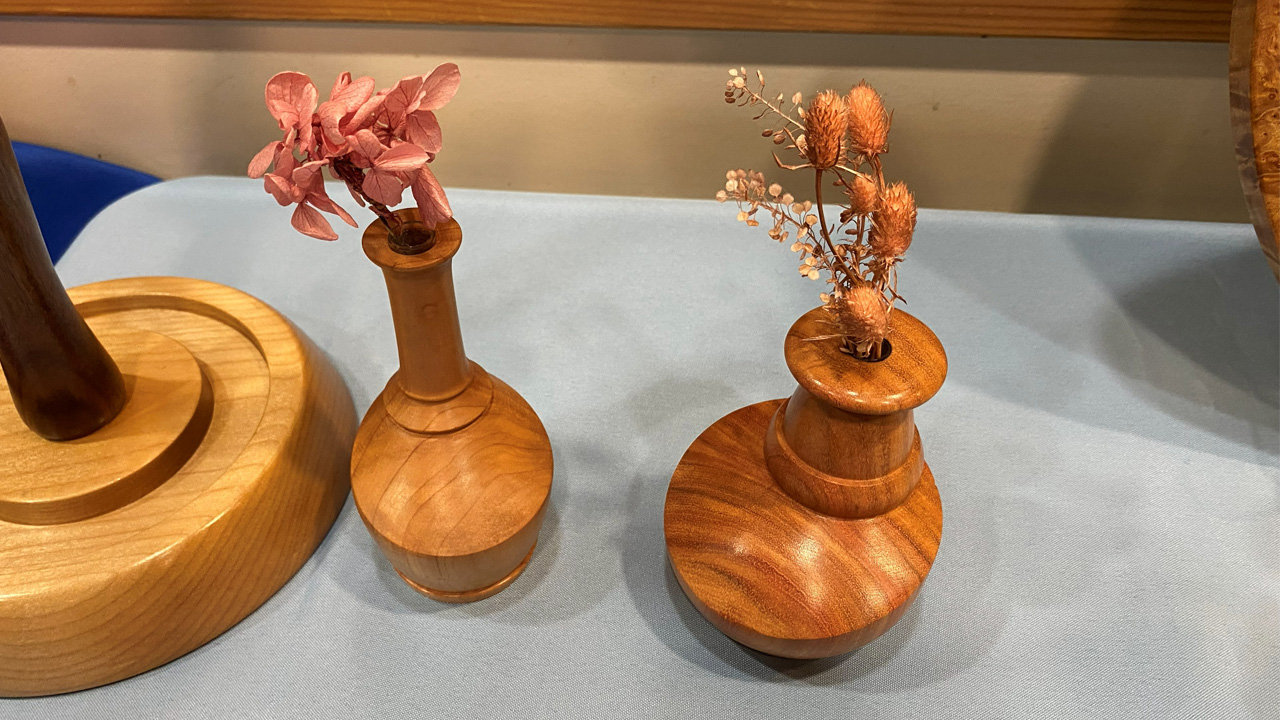
Claude Godcharles recently purchased a Vicmarc eccentric Chuck and he’s been playing around with offset turning. Claude showed two bud vases with off-center necks, one made of carab, the other maple.
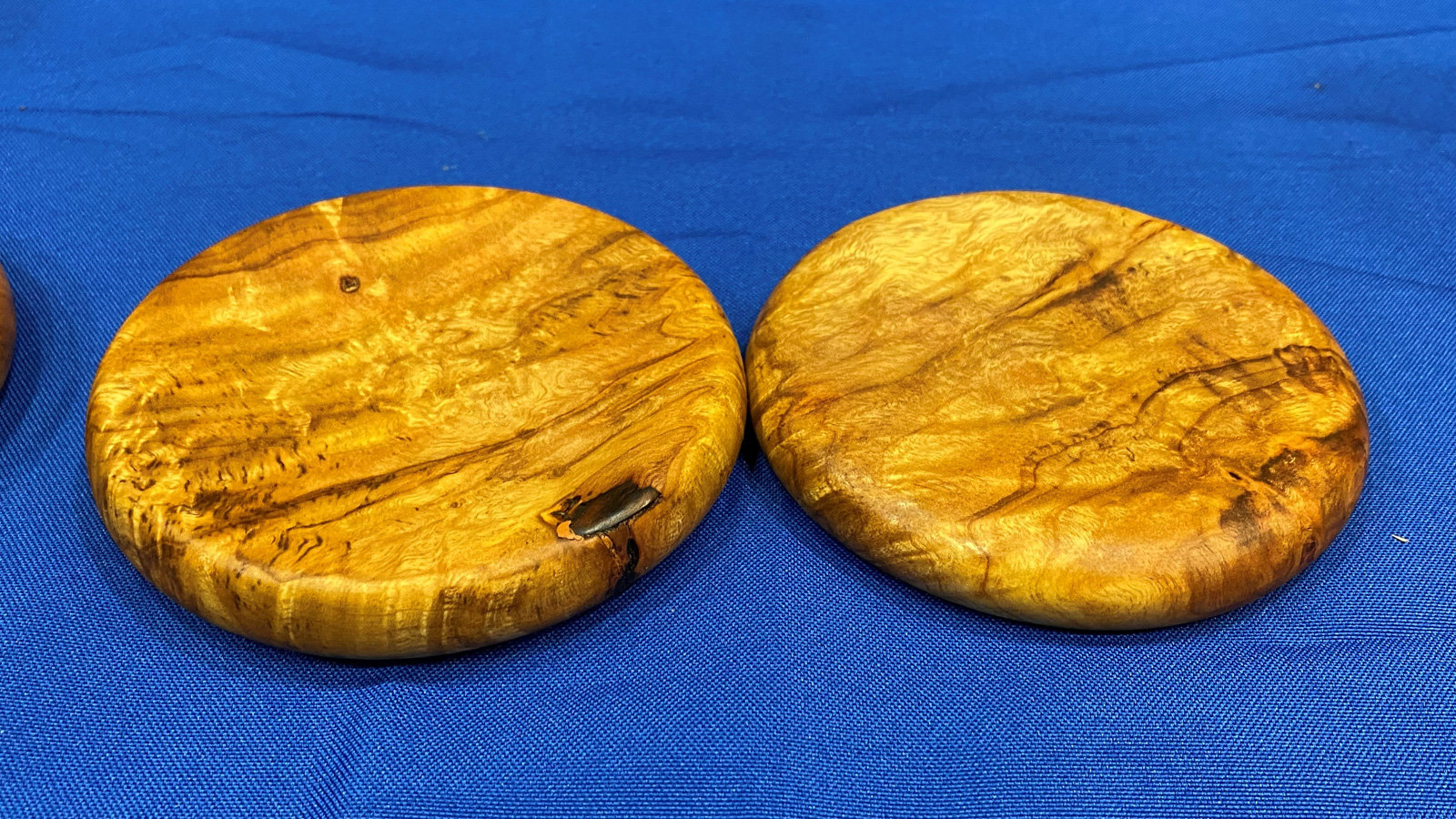
Jon Bishop made three pillows that he uses as coasters.
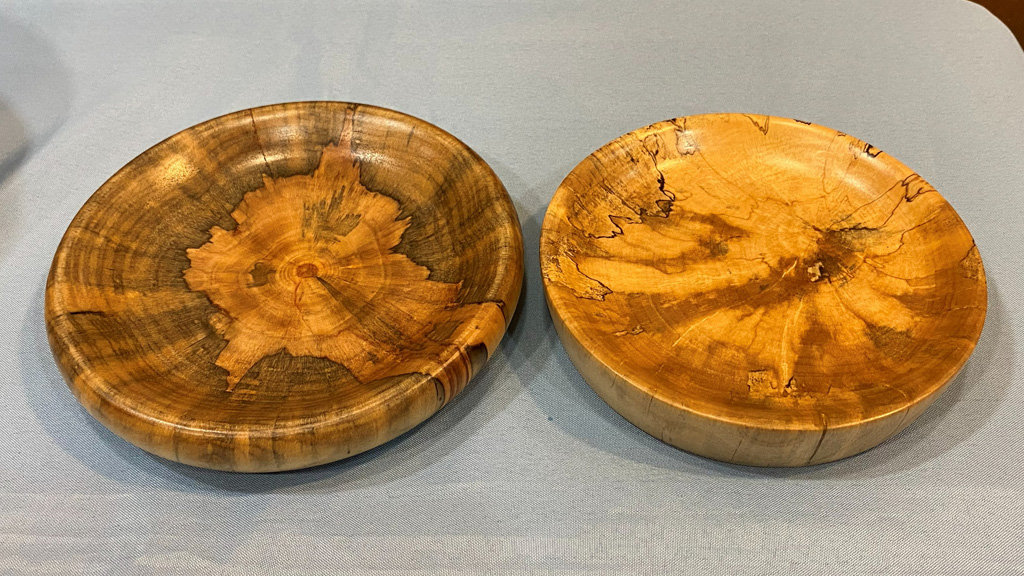
Kirsten Mouradian took some of her sphere turning failures and turned them into bowls. She made a jar for cat treats with one of her sphere failures becoming the lid.
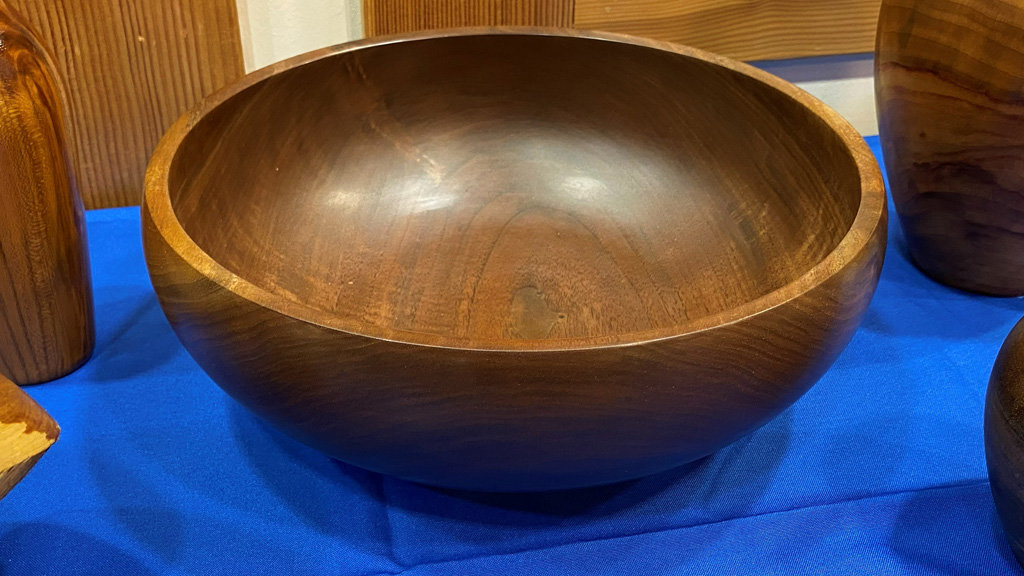
Dan Boehmke showed a large walnut calabash bowl, a camphor hollow form (finished with General Finishes) and a small hollow form vase of wood he obtained from Dennis.
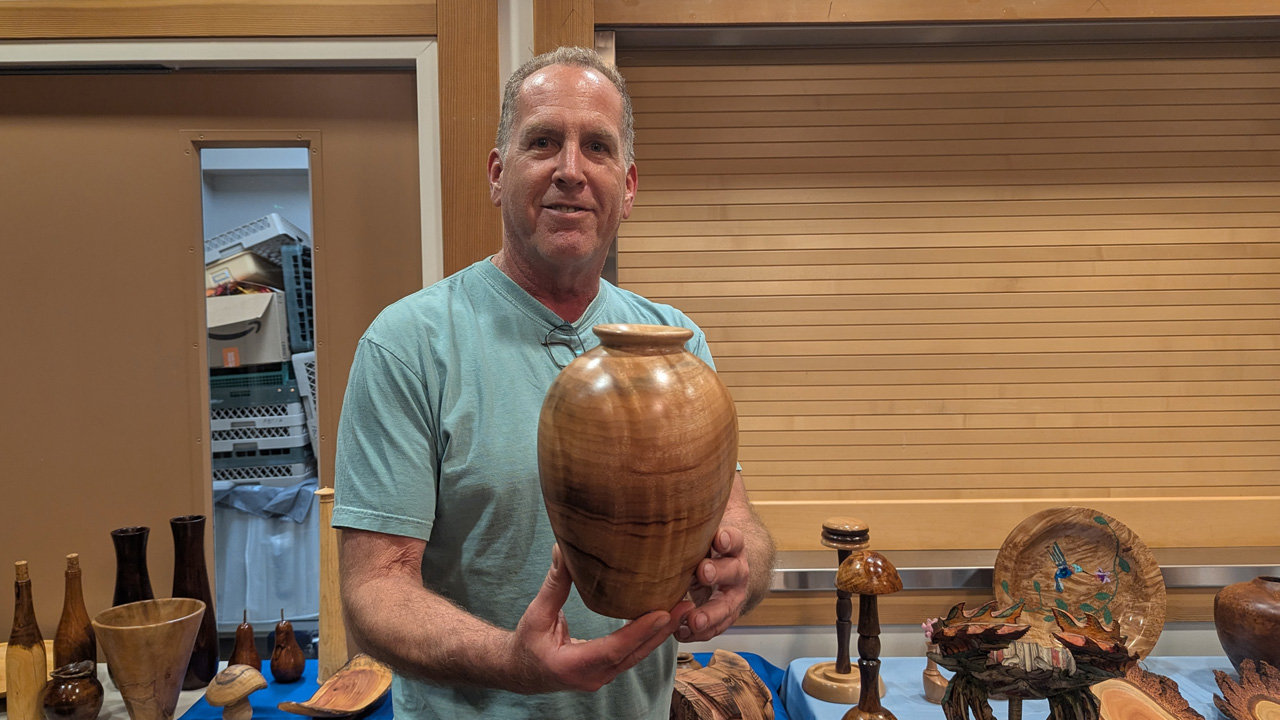
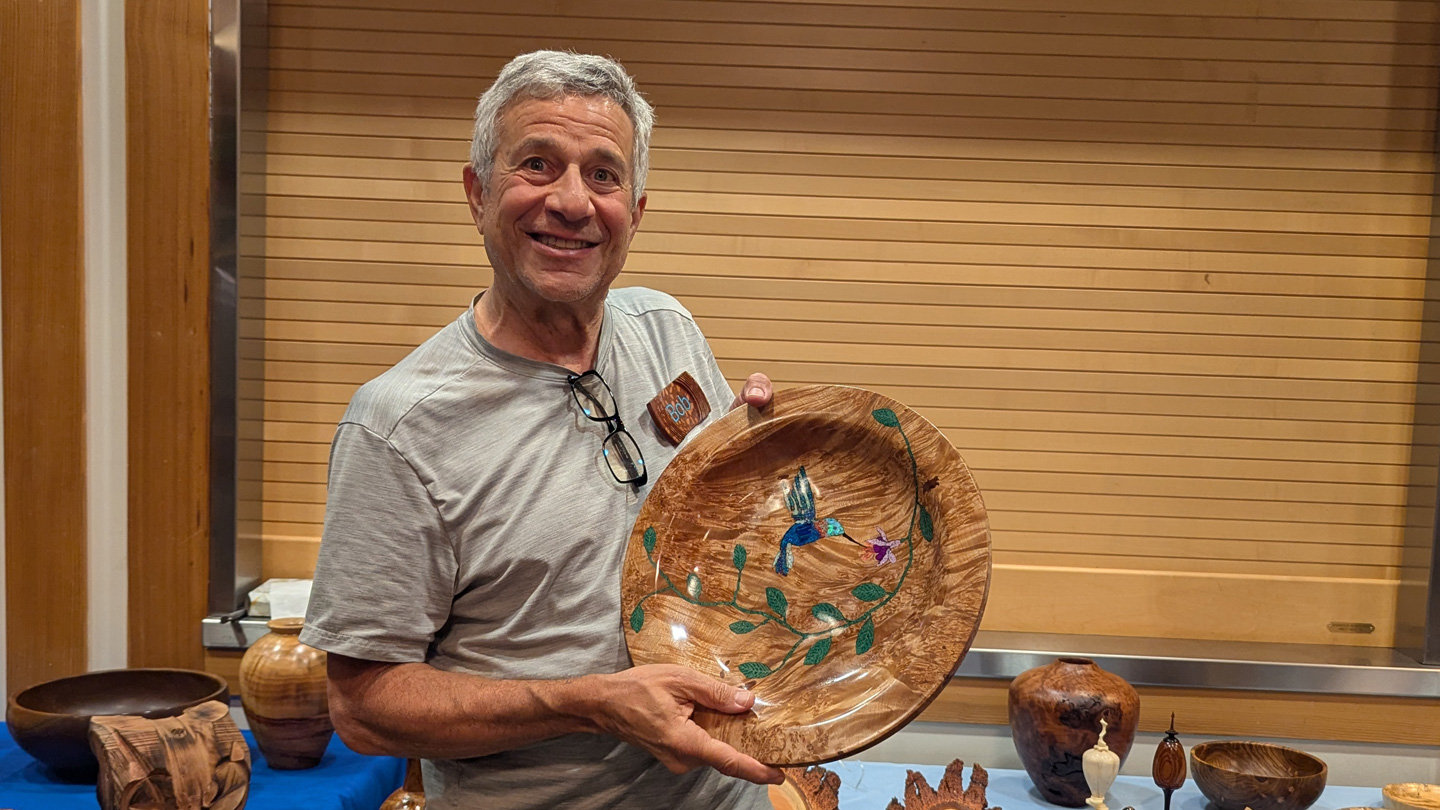
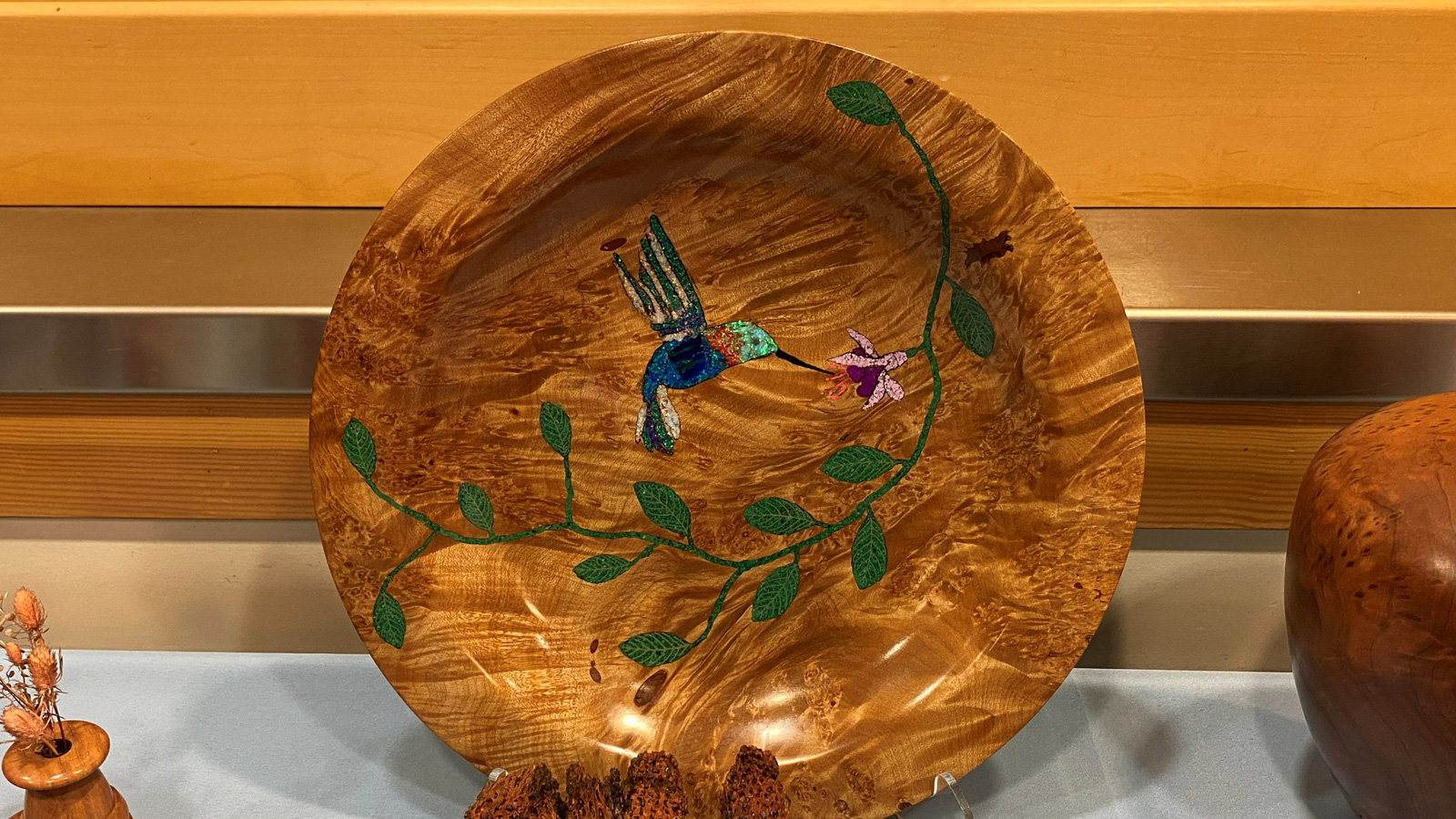
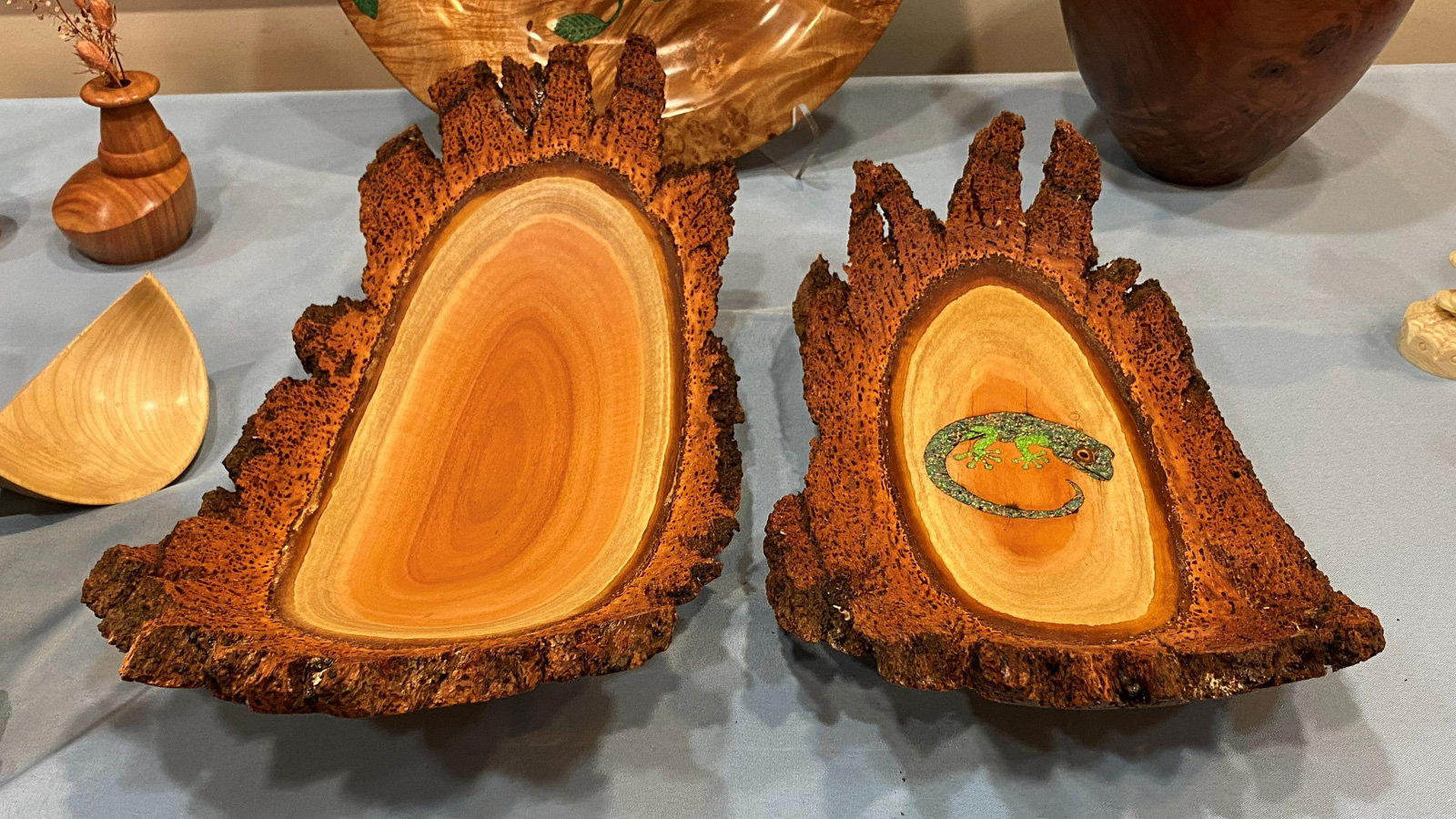
Bob Bley showed a Redwood burl hollow form finished with wipe on Poly. He also showed a large Maple Burl platter with a Hummingbird Opal pattern. Bob described in detail how he was able to achieve the fine details in the Hummingbird and the leaves on the platter. Bob also showed 2 platters with natural edges, made by coring one from the other. One of the platters was left with holes from his faceplate, so he created an inlaid stone lizard to hide them.
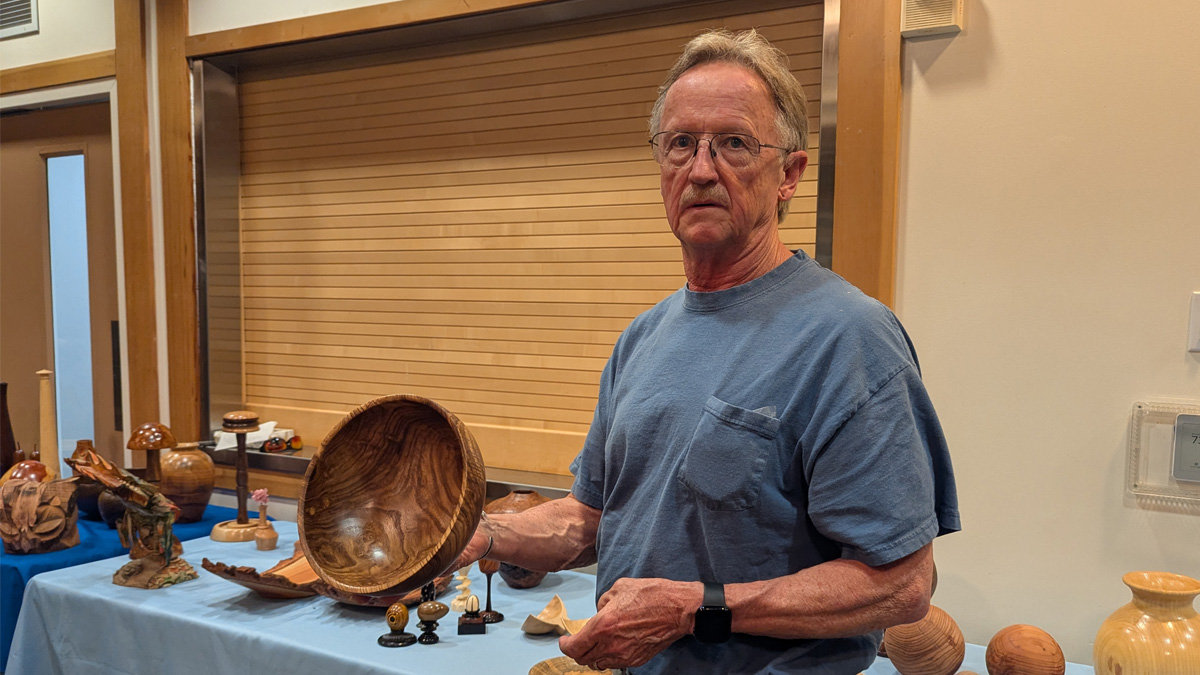
Tom Gaston turned two end-grain key bowls – one from Norfolk Island pine, the other from spalted Birch. Tom also showed a beautiful bowl made from mystery wood.
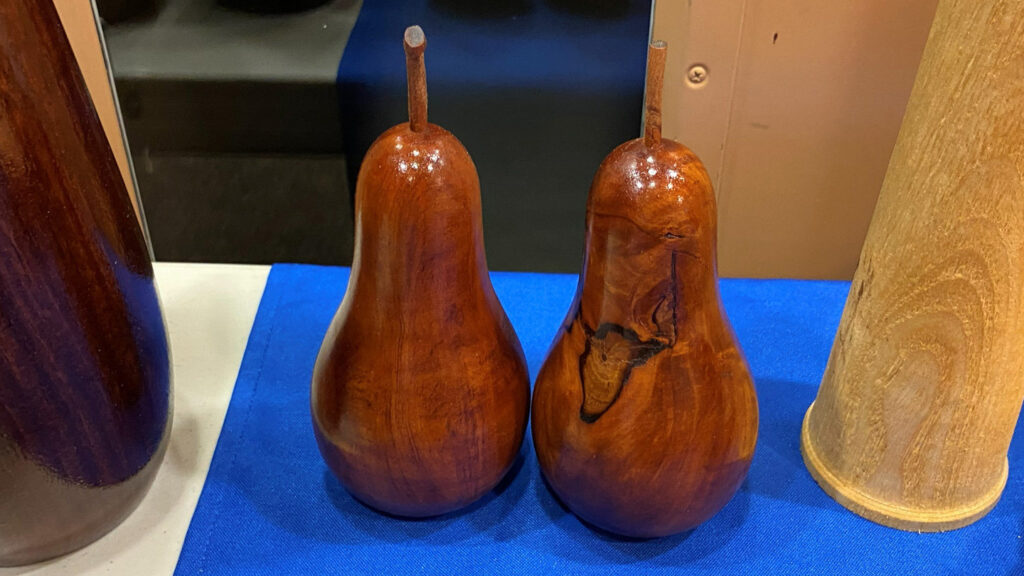
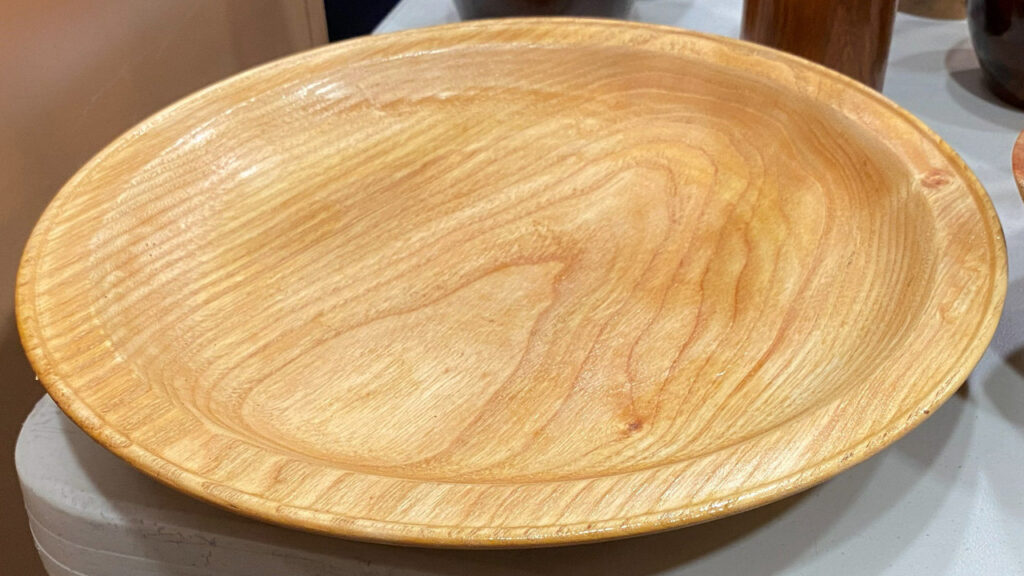
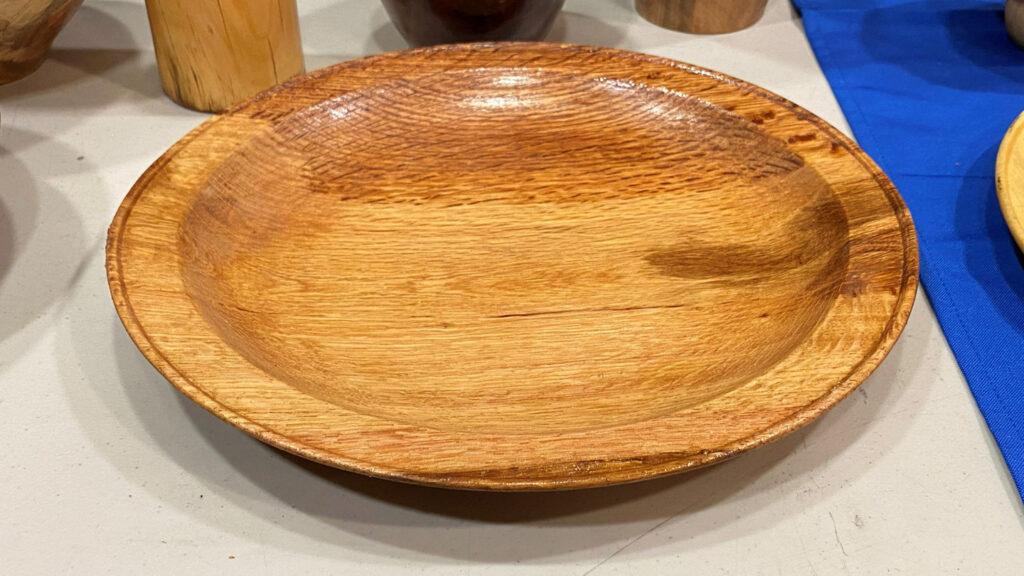
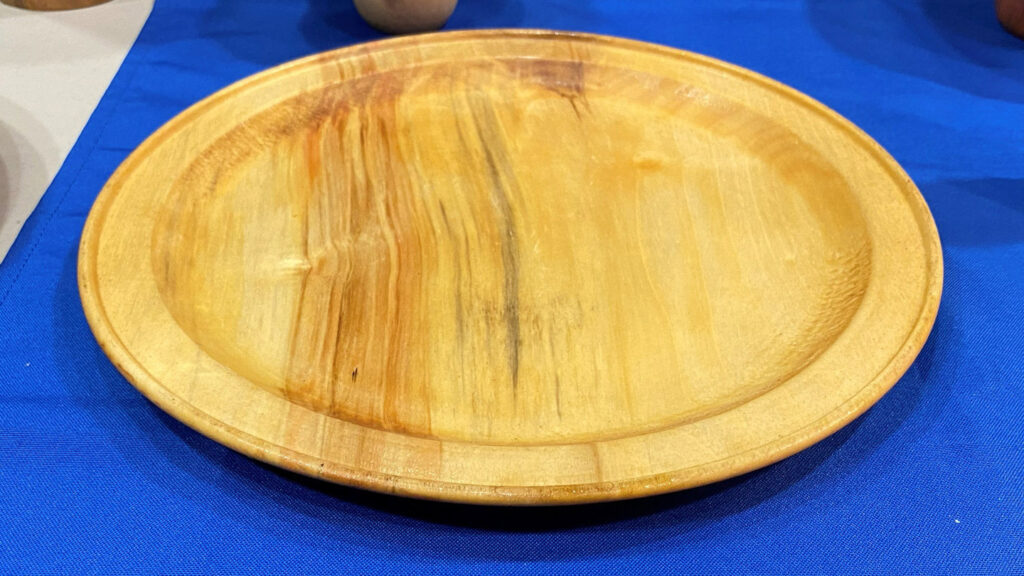
Kelly Smith turned a pair of beautiful pears from a dark-colored wood. He also turned large platters with bids on their rims from assorted hardwoods. Turning a bid definitely adds interest to any utilitarian-focused piece.
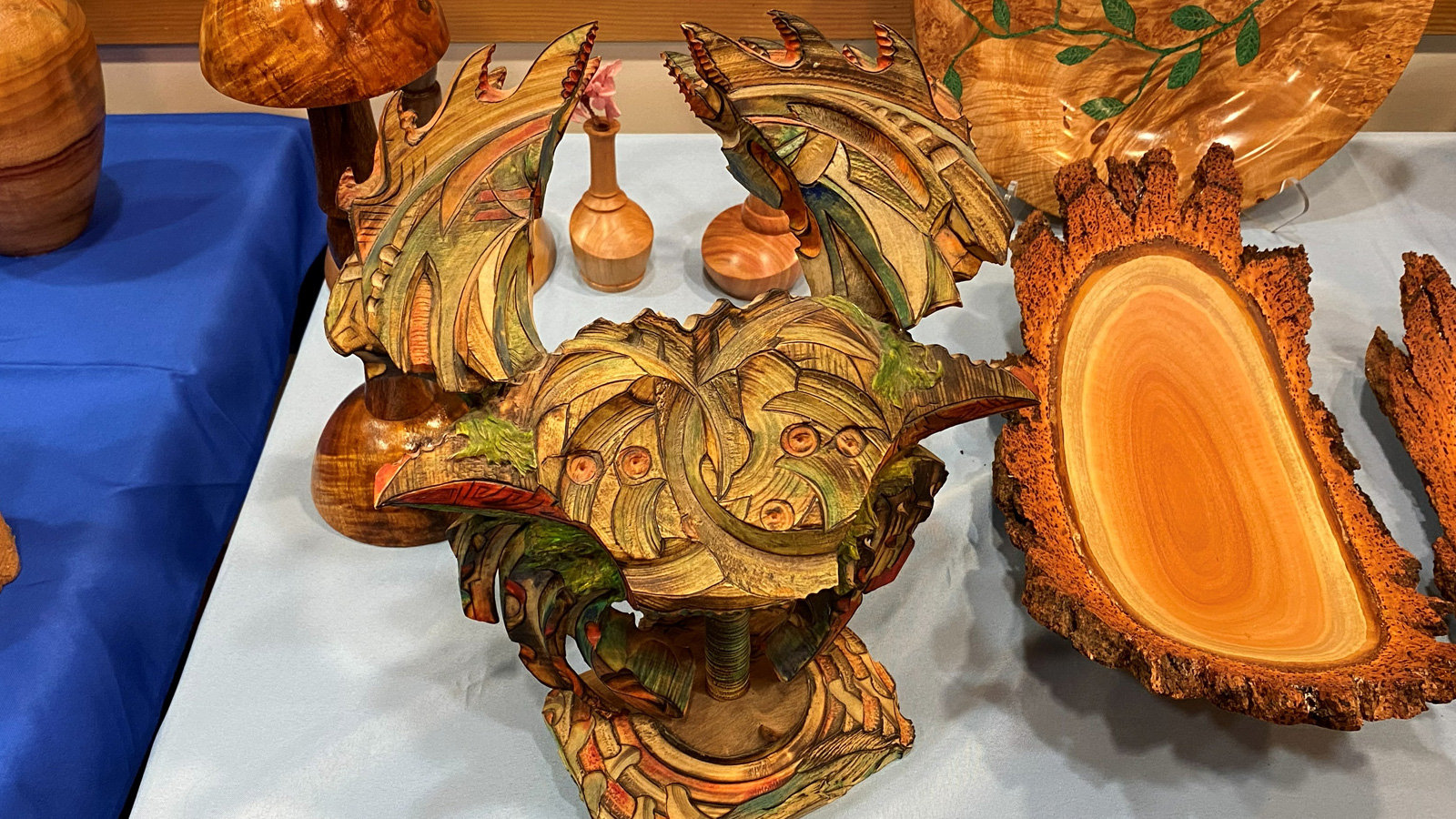
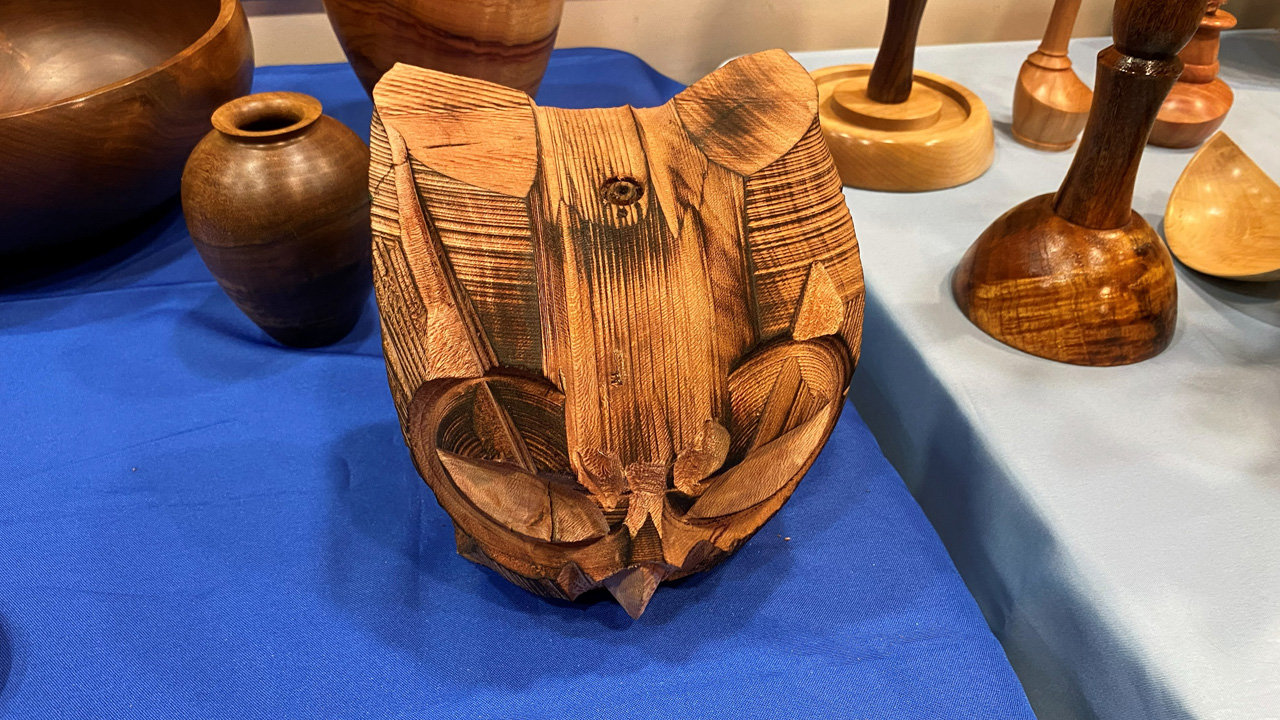
Ed Howes showed a crab that was created by Derek Weidman that his son had purchased seven or eight years ago. Alison Lee brought in the owl that Derek Weidman had made at Sunday’s demo.
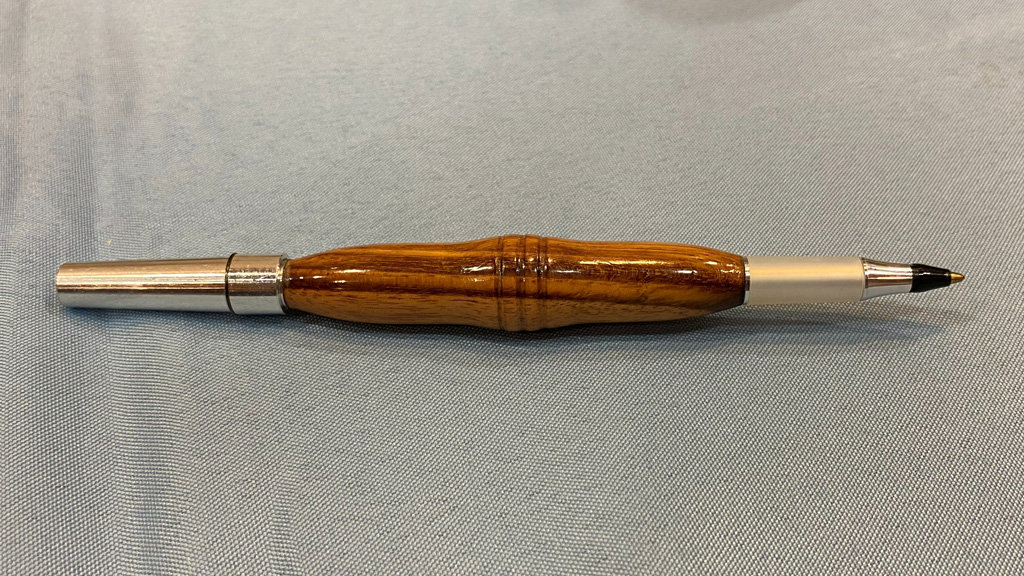
Thanks to Angela Gunn for letting us use her uniquely shaped pen at the meeting.
Participation Prizes
Edgar presented five items for the President’s Challenge and Show and Tell drawing prizes – pieces of osage orange, beech, drooping sheoak, olive, and $10 gift certificates from Woodcraft in San Carlos (thank you, Eric) and Craft Supplies.
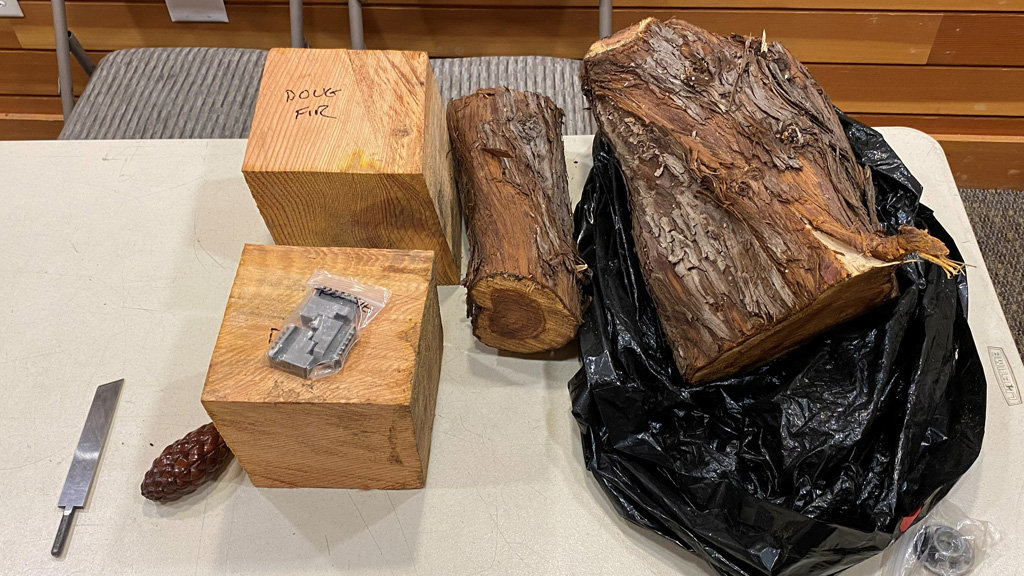
“As the Wood Turns” by Alison Lee (Guest)
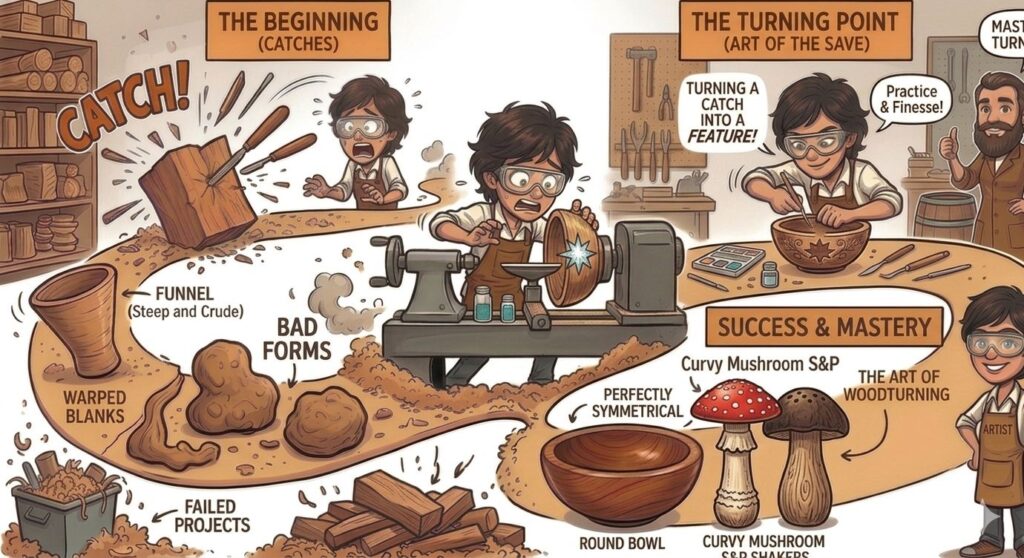
From Flat, Rectangular to Round, Cylindrical: Reflections from the First Year of Woodturning
A year ago, my woodworking world was defined by the tight joinery, perfect angles, parallel lines, and well-fitted wood joints. After taking the multi-day, bowl turning and spindle turning classes from Tina Chou, I dove into the world of woodturning. Flatwork projects involved up-front planning of drawings, cut lists, and digging through kiln-dried, rough lumber. Turning a wood blank often involves little or no explicit plan. The wood is free; harvested from downed trees with help from club members. Expenses come from purchasing turning and finishing tools.
Traditional woodworking builds function first. A table must be sturdy. A bookcase must hold books. Aesthetics came as the icing on the structural cake. In turning, the function is the form. You are not building to a shape but finding the shape within the wood. This begins with developing an eye for what to bandsaw to retain the best of the grain, character and heartwood of a rough blank. This is followed through with hours of practice to hone the eye, hand, and body coordination for effective woodturning and eventually being able to finesse the turning situation that a piece of wood presents.
Turning is subtractive. You do not aim for a final dimension from step one. You mount a rough blank and subtract material until a shape emerges. A woodturning tool is dynamic. The metal blade is moved to a screaming, spinning piece of wood as you anchor, bevel, and cut. The initial months were learning to “ride the bevel”, finding the angle where the wood is sliced, producing shavings rather than dust, and avoiding catches, skids, and funnels.
Woodworking has a lot of “stop and start” to measure, cut, check for square, repeat. Turning is a continuous event and occupies a unique space that bridges physical athleticism with aesthetic artistic expression. I am not just standing in front of the lathe. The body is a pivot point and I am shifting my weight from one foot to the other to guide the gouge along a curve to shape the wood into a pleasing result. It is a full-body engagement that woodworking rarely demands.
Turn-a-project is my way to improve my woodturning skills; opting only on rare occasion to do practice exercises. The gratification with the final outcome is vastly accelerated in woodturning. A cabinet or bed frame takes many weeks and months of labor. However, a calabash bowl from a piece of dried redwood can be turned and finished in a couple of days initially and now a single intense day. Regardless of success or failure, producing a piece, hopefully elegant, in a short period of time hooks you in to do yet another. Thus, the opportunity to practice, finesse, and learn from the successes and failures provide an effective means for improvement.
Mistakes occur in flatwork despite such maxims as “measure twice, cut once”. In fact, I consider the art in flatwork to be the “art of hiding the mistake” or the “art of the save”. I have had many mistakes in woodturning, be it catches, funnels, etc. The “art of the save” has rescued a few projects. For example, a bowl rim cracked partially or a knot that fell apart. The demo by Mark Gardner last fall on stepped rim rescued the cracked rim and the one-day workshop by Bob Bley on inlays was useful for the hole at the bottom of the bowl.
I have either enrolled in open woodshop classes or been a member of a woodshop to do flatwork. My own woodworking shop is small and limited with none of the big tools such as table saw, bandsaw, or jointer. I chose this route because of limited space, poor equipment maintenance know-how, and the enjoyment of working alongside other wood builders; seeing their projects emerge, and sharing tips, tricks, and techniques. I largely turn in my garage with a mini lathe to focus on turning. I get inspiration and advice through the woodturning clubs. Their monthly meetings, occasional workshops, demos from visiting woodturners are great opportunities to hear, see, network, and touch what people have turned.
A year or so later, the dichotomy of flat and round exists in my wood works. My main output comes from woodturning as I enjoy running on intuition and seeing what aesthetics emerge. The number of outcomes good enough to give away is three; one as holiday gift at woodturners holiday event, birthday gifts, and wig stand. I am still learning to develop a good eye to see the curves or the ghost outline and an ear to listen to the sound of wood as it spins, to feel the vibration, and a growing respect for the infinite shapes hidden within the heart of the tree. There is alot about woodturning to explore; beyond bowls and furniture spindles, and consist of different shapes, art forms, function, and even some off-axis turnings such as the great horned owl’s head by Derek Weidman. Spheres and eggs are now part of my repertoire as a result of Vic Mitnick’s and Edgar Whipple’s club demos. Soon, it will also include true hollow forms that Dennis Lillis started me on.
Woodturners Newsletter Editing Notes
WBW members, please let the newsletter editors know if you have a personal website, and would like it included in the President’s Challenge and Show & Tell sections of our Woodturning Newsletter. Email us at info@westbaywoodturners.com.
Board Members and Committee Chairs
President: Edgar Whipple
Vice President: Jon Bishop
Treasurer: Jim Koren
Secretary: Alison Lee
Member at Large: Bob Bley
Meeting Program Coordinator: Unfilled
Visiting Artist Coordinator: Dean Caudle (acting)
Anchor Seal: Dennis Lillis
Craft Supply: Tina
Librarian: Kelly Smith and Roman Chernikov
Audio Visual: Curtis Vose
Website: Roman Chernikov
Woodturners Newsletter: Angela, Edgar, David, Laura, and Roman
Leave a Reply
You must be logged in to post a comment.